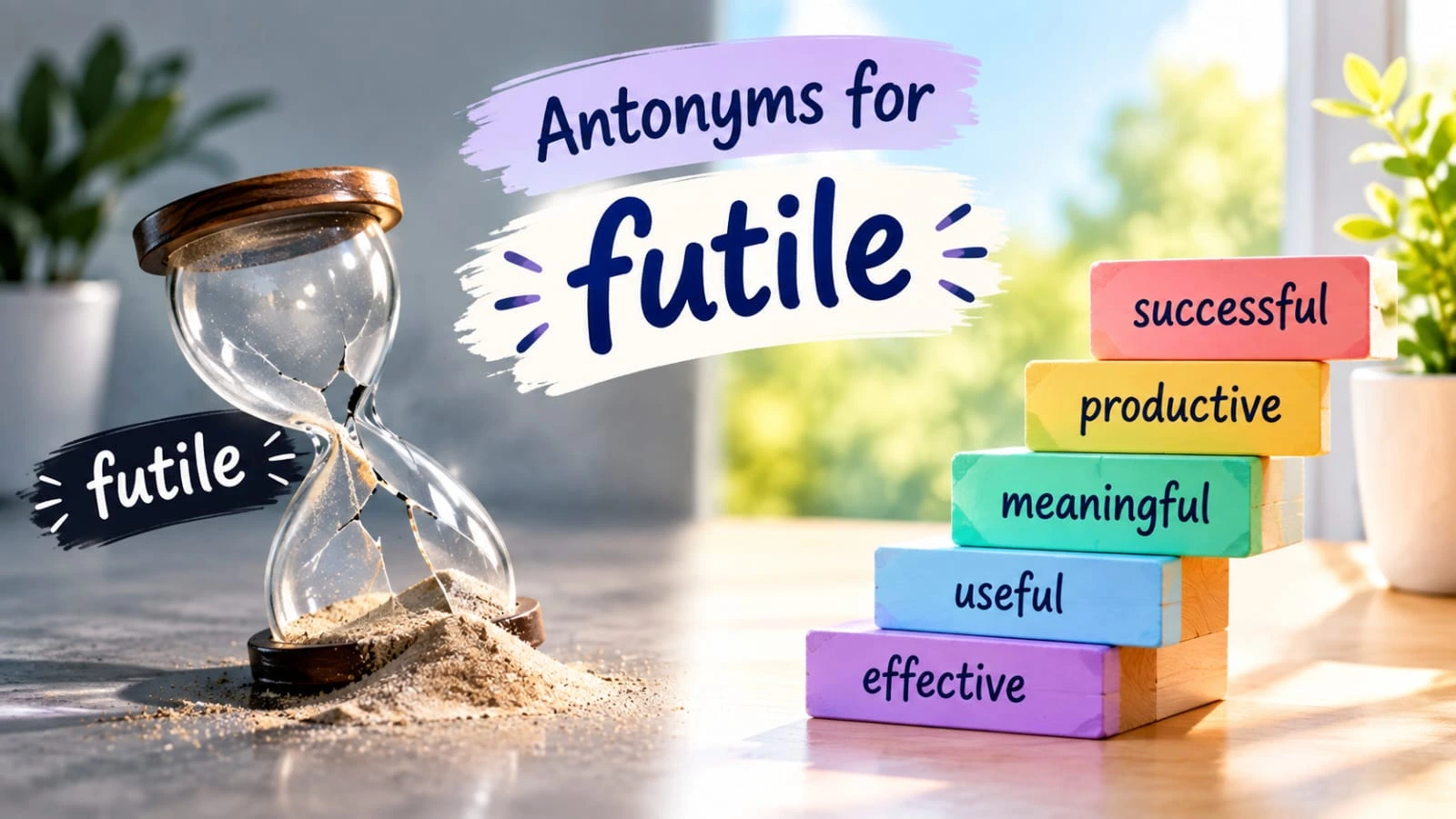
Antonyms for futile include effective, productive, useful, fruitful, successful, worthwhile, beneficial, practical, viable, and purposeful.
Quick Answer
Futile describes something that cannot produce a useful or successful result. Its most common opposite is effective. Other contextual antonyms include productive for work that achieves results, worthwhile for something valuable to do, and fruitful for an activity that produces good results.
Futile: Simple Definition
Futile: Unable to produce a useful, successful, or desired result.
Main antonym: Effective — successful in producing the intended result.
20 Antonyms for Futile
1. Effective
Producing the desired or intended result.
The new strategy proved effective in reducing costs.
2. Productive
Producing useful results or a significant amount of work.
The meeting was productive and ended with several clear decisions.
3. Useful
Having a practical purpose or providing a benefit.
The training provided useful information for new employees.
4. Fruitful
Producing good, valuable, or successful results.
Their discussion led to a fruitful partnership.
5. Successful
Achieving the result or goal that was intended.
The campaign was successful in attracting new customers.
6. Beneficial
Producing a positive advantage or helpful result.
Regular exercise can be beneficial to overall well-being.
7. Worthwhile
Worth the time, effort, or money spent on it.
Volunteering was a worthwhile experience.
8. Valuable
Useful, important, or helpful because it provides benefit.
Her feedback was valuable to the development team.
9. Practical
Likely to work successfully in real situations.
We need a practical solution to this problem.
10. Purposeful
Having a clear purpose or producing meaningful results.
She took a purposeful approach to improving her skills.
11. Meaningful
Having value, importance, or a useful purpose.
The project created meaningful opportunities for students.
12. Constructive
Helping to improve a situation or produce a positive result.
The manager gave constructive feedback to the employee.
13. Advantageous
Providing a benefit or putting someone in a better position.
The agreement was advantageous for both companies.
14. Rewarding
Providing satisfaction, benefit, or a valuable result.
Teaching can be a highly rewarding career.
15. Efficient
Achieving a result with little wasted time, effort, or resources.
The new system is more efficient than the old one.
16. Viable
Capable of working successfully or being developed successfully.
The team found a viable solution to the technical problem.
17. Feasible
Possible and practical to accomplish successfully.
The engineers proposed a feasible alternative.
18. Profitable
Producing financial gain or benefit.
The business became profitable within two years.
19. Promising
Showing signs that something is likely to succeed.
The early research produced promising results.
20. Impactful
Having a strong or noticeable effect.
The program had an impactful effect on the local community.
Which Antonym Should You Use?
The best opposite of futile depends on what you are describing.
Use effective when something successfully achieves its intended purpose.
Use productive when talking about work, activities, meetings, or efforts that produce useful results.
Use worthwhile when emphasizing that something is worth the time, effort, or resources invested in it.
Use fruitful when an activity produces valuable outcomes, ideas, discussions, or relationships.
Use feasible or viable when the focus is on whether a plan or solution can realistically work.
Use profitable when the result specifically involves financial gain.
Futile vs. Effective
The clearest contrast is:
- Futile: unlikely to produce the desired result.
- Effective: successful in producing the desired result.
For example:
Trying to repair the damaged machine without replacing the broken part was futile.
Replacing the damaged part was effective.
The two words create a direct contrast between failure to achieve a result and successful achievement of a result.
Meaning and Usage
Futile is commonly used for efforts, attempts, actions, arguments, struggles, or searches that are unlikely to succeed.
Its strongest opposite, effective, focuses specifically on whether something produces the intended outcome.
Other words have narrower meanings:
- Productive emphasizes useful output.
- Fruitful emphasizes good or valuable results.
- Worthwhile emphasizes value relative to effort or cost.
- Practical emphasizes real-world usefulness.
- Feasible emphasizes whether something can realistically be done.
- Viable emphasizes whether a plan, option, or idea can successfully continue or work.
Therefore, these words are useful contextual opposites, but they are not perfect substitutes for effective in every sentence.
Example Sentences
- The first attempt was futile, but the revised method was effective.
- Spending hours arguing without evidence was futile, while the research process was productive.
- The team abandoned a futile approach and developed a practical solution.
- Their initial search was futile, but the second investigation produced fruitful results.
- The proposal seemed futile at first, but the engineers later found a viable alternative.
- The extra training proved worthwhile because it improved the team’s performance.
Grammar and Word Class
Futile is an adjective.
Examples:
- The attempt was futile.
- They made a futile effort.
Most common antonyms in this article, such as effective, productive, useful, fruitful, successful, beneficial, practical, and worthwhile, are also adjectives.
The noun futility means the quality or condition of being futile.
Example:
They eventually recognized the futility of continuing the argument.
Common Mistake
Do not assume that useful and effective always mean exactly the same thing.
Something can be useful without achieving the specific result intended.
For example:
❌ The instructions were useful, so they were definitely effective.
✅ The instructions were useful and helped the team complete the task.
Effective specifically suggests that something achieves its intended purpose, making it the stronger direct antonym of futile.
Expert Tip
When replacing futile, first ask what kind of success you want to describe. Effective focuses on achieving a goal, productive focuses on output, worthwhile focuses on value, and feasible focuses on whether something can realistically be done.
Short Questions & Answers
What is the strongest antonym of futile?
Effective is the strongest general antonym of futile because it describes something that successfully produces the intended result.
What is the opposite of a futile effort?
The opposite of a futile effort is an effective effort or a productive effort, depending on whether you want to emphasize successful results or useful work.
Is useful an antonym of futile?
Yes, useful can be a contextual antonym of futile, especially when the contrast is between something that provides value and something that provides no useful result.
What is the opposite of a futile attempt?
Successful or effective can describe the opposite of a futile attempt. Effective is usually more precise when the attempt achieves its intended purpose.
Is worthwhile the opposite of futile?
Worthwhile can be a contextual opposite. It emphasizes that something deserves the time, effort, or resources invested in it, rather than being pointless or ineffective.
Conclusion
The clearest opposite of futile is effective, especially when describing an action or attempt that successfully achieves its intended goal. However, the best antonym can change with context. Productive works well for useful work, fruitful for activities that produce valuable results, worthwhile for efforts that deserve the investment, and feasible or viable for plans that can realistically work.
Choosing the right antonym therefore depends on the type of result you want to emphasize. Understanding these small differences can make your writing more precise and natural.
Antonyms for Commit: Avoid, Refrain & More

I’m Daniel Carter, a language enthusiast and content writer focused on the fascinating world of antonyms and vocabulary. I break down word meanings and opposites into simple, practical guides helping readers build a richer vocabulary, understand language more deeply, and speak or write with greater confidence.