What Is the Opposite of Option?
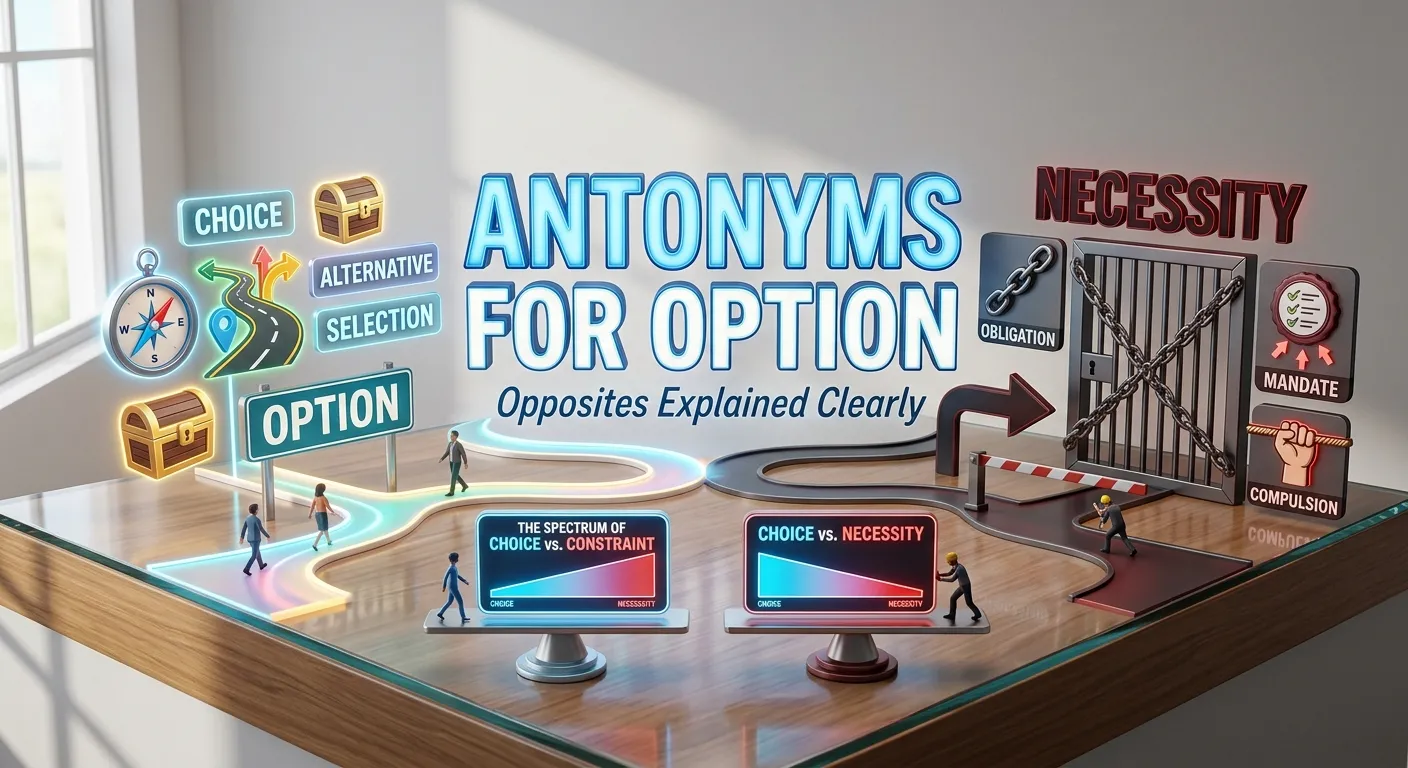
The strongest contextual antonym of option is obligation when option means a choice that you are free to make. Other opposites include necessity, requirement, constraint, and certainty, depending on the context. There is no single universal antonym for option.
The Short Answer
Option means a choice or possibility available to someone. Its opposite depends on what kind of contrast you mean.
The most useful contextual opposites are:
- obligation: something you must do rather than choose
- necessity: something required by circumstances
- requirement: something that must be done or provided
- constraint: a limit that reduces available choices
- restriction: a rule that limits what can be chosen or done
- compulsion: being forced to act
- impossibility: something that cannot be chosen or done
- certainty: a definite outcome rather than one of several possibilities
The most natural choice is usually obligation when the contrast is between freedom to choose and being required to act.
Option vs. Its Opposite
| Word | Meaning | Example |
| option | A choice or possibility available to someone | We have several options. |
| obligation | Something you are required to do | Paying the bill is an obligation. |
| necessity | Something that is needed or unavoidable | Water is a necessity. |
| requirement | Something that must be fulfilled | A passport is a requirement for the application. |
| constraint | A limit that restricts choices | Budget constraints reduced our options. |
| impossibility | Something that cannot happen or be chosen | Cancellation was an impossibility at that stage. |
Meaning in Brief
Option: a choice or possibility that is available to someone.
Main contextual antonym: obligation — something that a person is required to do rather than freely choose.
What You’ll Learn
After reading this guide, you will know:
- Why option has no single universal antonym
- Which words contrast with option in different situations
- The difference between obligation, necessity, and requirement
- How constraint and restriction reduce available options
- How to choose the right opposite in a sentence
Main Antonyms for Option
1. Obligation
Obligation is one of the clearest opposites of option when the contrast is between choice and duty.
An option is something you may choose. An obligation is something you must do.
Example:
Attending the meeting is not an option; it is an obligation.
Best contrast: freedom of choice vs. duty.
2. Necessity
Necessity means something that is needed or unavoidable.
It contrasts with option when something is not merely one possible choice but something that must happen because of circumstances.
Example:
In an emergency, evacuation may become a necessity rather than an option.
Best contrast: possibility or choice vs. something unavoidable.
3. Requirement
A requirement is something that must be satisfied, completed, or provided.
Example:
Providing identification is a requirement, not an option.
The distinction is especially useful in school, workplace, legal, application, and administrative contexts.
Best contrast: something you may choose vs. something you must fulfill.
4. Constraint
A constraint is a limitation that restricts what someone can do or choose.
It is not a direct lexical antonym of option, but it can represent the opposite concept in contexts involving choice and freedom.
Example:
Financial constraints left us with very few options.
Here, constraint describes what reduces the available choices.
5. Restriction
A restriction is a rule, condition, or limitation that prevents or limits certain choices or actions.
Example:
The new restrictions left customers with fewer options.
Like constraint, restriction is best treated as a contextual opposite rather than a universal antonym.
6. Compulsion
Compulsion means being forced or strongly driven to do something.
It contrasts with option when a person has no genuine freedom of choice.
Example:
He signed the agreement under compulsion, not by free choice.
Best contrast: free choice vs. forced action.
7. Impossibility
Impossibility describes something that cannot happen or cannot be done.
It can contrast with option when option means a possibility that is available.
Example:
With the deadline already passed, cancellation was an impossibility.
However, this is a contextual contrast rather than a standard dictionary-style antonym.
8. Certainty
Certainty means a definite or assured outcome.
This can contrast with option when option is being used in the broader sense of an alternative possibility.
Example:
The contract provides certainty rather than several possible outcomes.
This relationship is weaker than option vs. obligation, so certainty should not normally be presented as the default antonym.
Choosing the Right Antonym
The opposite of option changes according to the intended meaning.
When Option Means “Something You May Choose”
Use:
- obligation
- requirement
- necessity
- compulsion
Example:
Working overtime is an option.
Opposite idea:
Working overtime is an obligation.
The contrast is choice vs. duty.
When Option Means “A Possibility”
Use:
- impossibility
- certainty, in some contexts
Example:
Moving abroad is one option.
If moving abroad is impossible, it is no longer an available option.
When Option Means “An Available Choice Among Alternatives”
Use:
- constraint
- restriction
- limitation
Example:
We had several options.
Budget constraints left us with only one choice.
Here, the constraint does not mean “the opposite of option” literally. It reduces or removes available options.
Antonym Differences Explained
The most important distinction is between obligation, necessity, and requirement.
Obligation vs. Necessity
An obligation usually comes from a duty, responsibility, agreement, rule, or expectation.
I have an obligation to pay the loan.
A necessity is something required by circumstances or practical conditions.
Food is a necessity.
So, obligation often concerns what a person must do, while necessity can concern what is needed or unavoidable.
Requirement vs. Obligation
A requirement is a condition that must be met.
A valid ID is a requirement.
An obligation is more often a duty or responsibility.
I have an obligation to support my family.
They can overlap, but they are not interchangeable in every sentence.
Constraint vs. Restriction
A constraint is a limitation that affects what is possible.
Time constraints limited our options.
A restriction is often an imposed rule or limitation.
The website has age restrictions.
Both can reduce options, but neither is a perfect one-word antonym of option.
Examples in Context
Everyday Life
Choosing the blue shirt is an option.
Wearing the required uniform is an obligation.
Workplace
Working from home is an option for some employees.
Completing the safety training is a requirement.
Education
Students have several course options.
Completing the final exam is a requirement.
Financial Decisions
Buying a new car is an option.
Paying essential bills may be a necessity.
Limited Choices
We had several options at first.
Budget constraints reduced our options to two.
Forced Action
He accepted the offer as a free choice.
She acted under compulsion.
How These Words Work in a Sentence
Option is a countable noun.
We have three options.
That is not an option.
Its main contextual opposites are also nouns:
- obligation
- necessity
- requirement
- constraint
- restriction
- compulsion
- impossibility
- certainty
A useful sentence pattern is:
X is an option.
The contrasting structure is often:
X is an obligation.
X is a requirement.
And X is a necessity.
Notice that these words do not always produce the same meaning. The correct choice depends on why X is no longer optional.
Commonly Confused Opposites
“No option” vs. “obligation”
These ideas are related but not identical.
We had no option but to leave.
This means there was no alternative available.
We had an obligation to leave.
This means there was a duty or requirement to leave.
The first focuses on lack of choice; the second focuses on duty.
“Requirement” vs. “necessity”
Do not automatically use them as synonyms.
A visa is a requirement for this application.
Clean water is a necessity for human life.
A requirement is often tied to a particular rule or condition, while a necessity is something needed or unavoidable.
“Constraint” vs. “option”
A constraint does not directly mean “the opposite of option.”
Time constraints reduced our options.
This is more accurate than:
❌ Time constraints are the antonym of option.
A constraint limits options; it is not normally a direct antonym of the noun.
Teacher’s Tip
When someone asks for the opposite of option, first ask what kind of “opposite” they mean:
choice vs. duty → obligation
choice vs. unavoidable need → necessity
choice vs. formal condition → requirement
choice vs. limitation → constraint/restriction
choice vs. force → compulsion
This is more accurate than treating one word as the universal antonym.
Quick Practice
1. Choose the best word.
“Submitting the completed form is a ______, not an option.”
A. constraint
B. requirement
C. possibility
Answer: B. requirement
A requirement is something that must be fulfilled.
2. Which word best contrasts with free choice?
A. obligation
B. possibility
C. alternative
Answer: A. obligation
An obligation is a duty that someone is required to fulfill.
3. Which word describes something that limits available choices?
A. certainty
B. constraint
C. option
Answer: B. constraint
A constraint places a limit on what someone can choose or do.
Common Questions About Option
What is the opposite of option?
There is no single universal antonym for option. Obligation is a strong contextual opposite when the contrast is between something you may choose and something you must do. Necessity, requirement, and constraint can fit other contexts.
Is obligation the direct antonym of option?
Not in every context. Obligation is a strong contextual opposite when option means a free choice. However, option can also mean a possibility or alternative, in which case another contrasting word may be more appropriate.
What is the opposite of “optional”?
The clearest opposite of optional is mandatory or required. This is slightly different from option, because optional is an adjective while option is a noun.
What is the difference between an option and a requirement?
An option is something available for you to choose, while a requirement is something you must satisfy or complete.
Can constraint be used as an antonym of option?
Constraint can work as a contextual opposite because it limits available choices, but it is not a direct antonym in every situation. For example, “budget constraints reduced our options” is natural and precise.
What to Remember
Option is unusual because it does not have one universal antonym.
The most useful contextual contrasts are:
- obligation : something you must do
- necessity : something needed or unavoidable
- requirement : something that must be fulfilled
- constraint : a limitation on choice
- restriction : an imposed limitation
- compulsion : being forced to act
- impossibility : something that cannot be done
- certainty : a definite outcome rather than an alternative possibility
For most questions about choice versus duty, obligation is the strongest answer. But when the intended meaning is “available possibility,” impossibility or another contextual contrast may be more appropriate.
Antonyms for Duration: Words for Short or Limited Time

I’m Daniel Carter, a language enthusiast and content writer focused on the fascinating world of antonyms and vocabulary. I break down word meanings and opposites into simple, practical guides helping readers build a richer vocabulary, understand language more deeply, and speak or write with greater confidence.