Quick Answer
| Term | Quick Answer |
|---|---|
| Mercantilism | Government-controlled trade to build national wealth |
| Main opposite | Free trade |
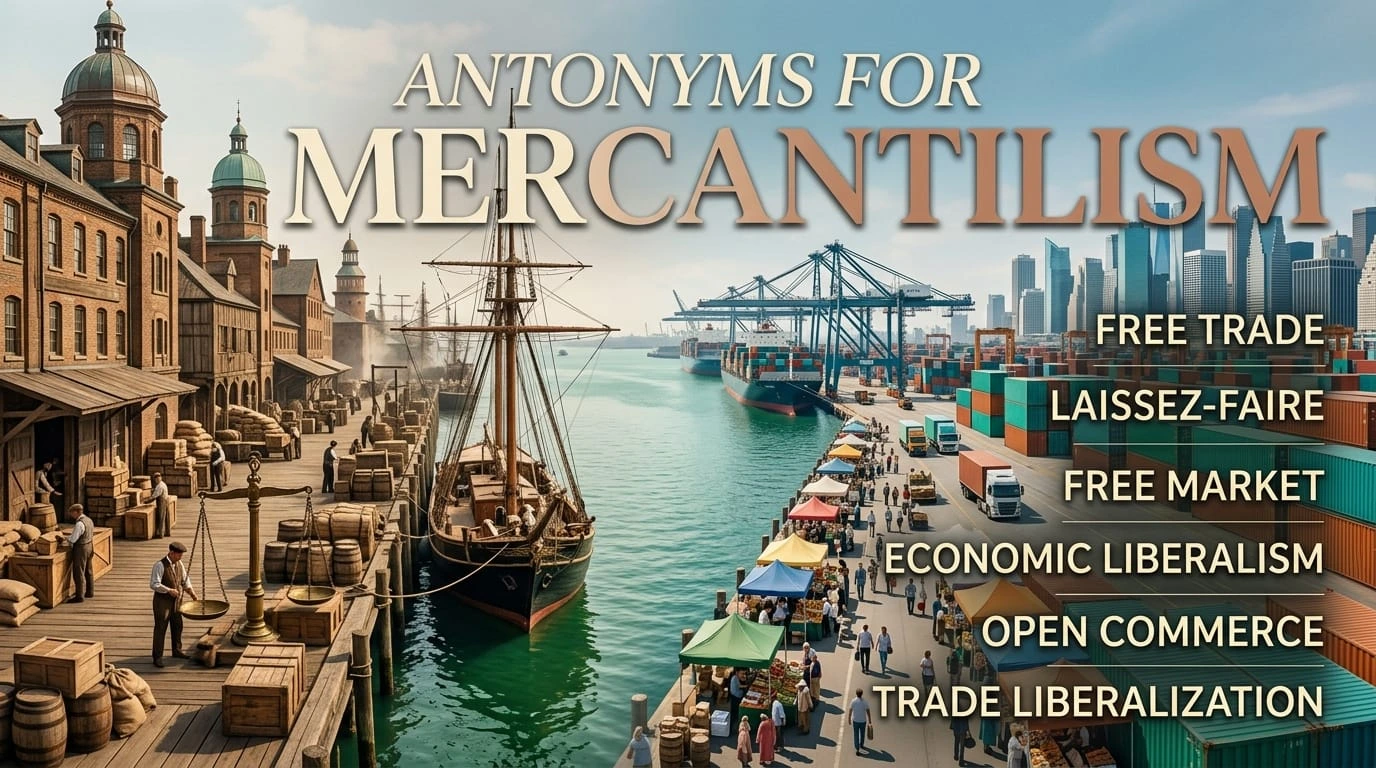
| Other alternatives | Economic liberalism, laissez-faire economics, trade liberalization |
What is the opposite of mercantilism?
Mercantilism is an economic system that seeks to strengthen a nation’s wealth and power through trade controls, export promotion, and the accumulation of precious metals. Its main contrasts include free trade, economic liberalism, and laissez-faire economics. These terms are related but not interchangeable: each describes a different approach to government involvement in the economy.
Mercantilism vs. Its Opposites
| Word | Meaning | Example |
| Mercantilism | Government-guided trade to increase national wealth | The government restricted imports to protect domestic producers. |
| Free trade | International trade with fewer barriers | The country reduced tariffs to encourage imports. |
| Laissez-faire economics | An approach favoring minimal government intervention in the economy | The government allowed businesses to set prices with little interference. |
| Economic liberalism | An approach favoring economic freedom and market activity | The reform reduced state controls over private businesses. |
Mercantilism is an economic doctrine associated with state-directed trade policies and the pursuit of trade surpluses. Free trade, laissez-faire economics, and economic liberalism provide useful contrasts, but they differ in scope.
Common Opposites of Mercantilism
1. Free Trade (Noun)
Meaning: International trade with few or reduced government-imposed barriers.
Example: The country adopted free trade and lowered tariffs on imported goods.
Why it contrasts: Mercantilist policies often restrict imports, while free trade seeks to reduce trade barriers.
2. Laissez-Faire Economics (Noun)
Meaning: An economic approach that favors minimal government intervention in business and markets.
Example: The policy followed a laissez-faire approach and allowed businesses greater freedom.
Why it contrasts: Mercantilism relies on government direction of trade, while laissez-faire favors less economic intervention.
3. Economic Liberalism (Noun)
Meaning: An economic philosophy that supports market freedom, private enterprise, and limits on unnecessary government control.
Example: Economic liberalism encouraged the government to remove restrictions on private trade.
Why it contrasts: Economic liberalism challenges many controls associated with mercantilism, although it does not require the complete absence of government.
4. Free-Market Economics (Noun)
Meaning: An economic system in which prices and production are largely shaped by supply and demand.
Example: The reform moved the country toward a free-market economy.
Why it contrasts: Mercantilism uses government policies to direct trade toward national goals, whereas a free-market approach gives market forces a greater role.
5. Free Enterprise (Noun)
Meaning: A system that allows individuals and businesses to own property, compete, and conduct business with relative freedom.
Example: Free enterprise allowed local firms to compete without special government privileges.
Why it contrasts: Free enterprise emphasizes business freedom rather than government-directed commercial advantage.
6. Open Trade (Noun)
Meaning: Trade between countries with relatively few restrictions.
Example: Open trade gave local companies access to more international suppliers.
Why it contrasts: Open trade reduces the barriers often used in mercantilist policies.
7. Trade Liberalization (Noun)
Meaning: The process of reducing tariffs, quotas, and other barriers to international trade.
Example: Trade liberalization made it easier for foreign products to enter the market.
Why it contrasts: Mercantilist policies often protect domestic industries through trade restrictions, while trade liberalization reduces them.
8. Economic Openness (Noun)
Meaning: The extent to which an economy engages in international trade and investment.
Example: Greater economic openness helped the country attract foreign investment.
Why it contrasts: Economic openness emphasizes international economic exchange rather than restricting it to protect national commercial interests.
9. Noninterventionism (Noun)
Meaning: The policy of avoiding intervention in a particular activity or area.
Example: The government adopted a noninterventionist approach to private business decisions.
Why it contrasts: It can oppose government direction of economic activity, but its meaning depends on the context and does not always refer specifically to trade.
10. Liberal Trade Policy (Noun Phrase)
Meaning: A trade policy that favors fewer restrictions and greater freedom for international commerce.
Example: The new liberal trade policy reduced import duties on essential goods.
Why it contrasts: It moves away from protectionist measures commonly associated with mercantilism.
Choosing the Right Antonym
The best opposite depends on the point you want to make.
- For international trade: Use free trade or open trade.
- For reducing tariffs and quotas: Use trade liberalization.
- For less government control of markets: Use laissez-faire economics.
- For greater business freedom: Use free enterprise or free-market economics.
- For a broader economic philosophy: Use economic liberalism.
These terms are related alternatives, not exact dictionary antonyms. Mercantilism is a specific economic doctrine, so its opposite is best explained through the particular policy or principle being contrasted.
Mercantilism and Its Antonyms in Sentences
- Mercantilism vs. free trade: Mercantilism favors strategic trade controls, while free trade seeks to reduce barriers between countries.
- Mercantilism vs. laissez-faire economics: Mercantilism uses government intervention to pursue national economic goals, while laissez-faire favors limited intervention.
- Mercantilism vs. trade liberalization: Mercantilist policies may restrict imports, while trade liberalization reduces barriers.
- Mercantilism vs. free enterprise: Mercantilism may grant advantages to selected industries, while free enterprise emphasizes business freedom and competition.
5 Synonyms for Mercantilism
Mercantilism has no perfect synonyms, but these five related terms can be useful depending on the context.
- Protectionism: A policy of protecting domestic industries from foreign competition.
- Economic nationalism: An approach that prioritizes national economic interests.
- Trade protectionism: The use of tariffs and restrictions to limit foreign competition.
- State interventionism: Government involvement in economic activities and markets.
- Export-oriented policy: An approach that promotes exports to support economic growth.
Note: These are related terms, not exact synonyms. Mercantilism is a specific historical economic doctrine, while each term describes a broader or narrower concept.Common Questions About Mercantilism and Its Opposites
FAQs
What is the main antonym of mercantilism?
Free trade is a strong practical opposite when the focus is international trade. It emphasizes fewer trade barriers, whereas mercantilism commonly uses restrictions to pursue national economic goals.
Is capitalism the opposite of mercantilism?
No. Capitalism is not a direct antonym of mercantilism. Mercantilism can operate alongside private ownership and commercial activity. The stronger contrast is usually free trade or a less interventionist economic approach.
Is laissez-faire the same as free trade?
No. Free trade focuses on reducing barriers to international trade. Laissez-faire is broader and favors limited government intervention in economic activity.
Is protectionism the opposite of mercantilism?
No. Protectionism is generally associated with mercantilism because both can involve tariffs, import restrictions, and support for domestic industries.
Can economic liberalism replace mercantilism in a sentence?
Sometimes. Economic liberalism works when the sentence contrasts broad economic philosophies. For a sentence specifically about tariffs or import restrictions, free trade or trade liberalization is usually more precise.
Conclusion
The most useful antonym for mercantilism is usually free trade, especially when discussing international commerce. Other useful contrasts include laissez-faire economics, economic liberalism, free-market economics, and trade liberalization. Each highlights a different aspect of economic freedom, from fewer trade barriers to less government intervention. These terms should not be treated as perfect synonyms for one another. For accurate writing, identify whether you are discussing international trade, business freedom, or the role of government before choosing an opposite.
Antonyms for Monopoly:20 Words for Market Freedom

I’m Moazama Akbar, an English language researcher and content writer with a passion for helping people build stronger vocabulary and language skills. I create clear, well-researched guides on antonyms, opposite words, and word meanings, designed to make English learning simple, practical, and enjoyable for students, writers, and learners everywhere.