The Main Antonym Explained
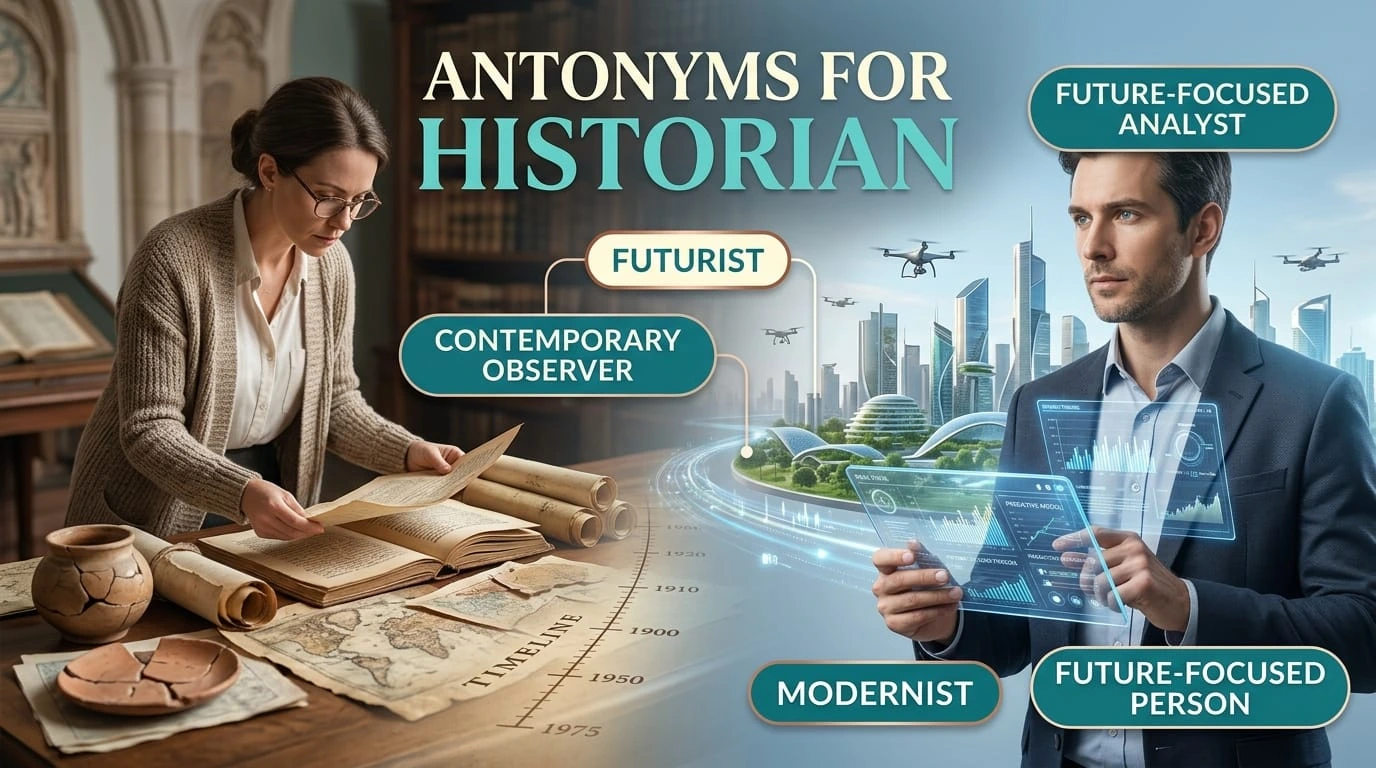
There is no exact, universal antonym for historian. A historian studies and interprets the past, while a futurist focuses on possible future developments and trends. Depending on context, forecaster or futurist thinker may also provide a useful contrast, but they are not strict dictionary antonyms.
The Short Answer
A historian is a person who researches, studies, and writes about the past. Because the word identifies a profession or field of expertise rather than a quality with a natural opposite, it does not have a single standard antonym.
The closest contextual contrast is:
Historian → Futurist
A historian looks primarily toward the past, while a futurist studies trends and possibilities to think about the future.
Other words such as forecaster and predictor can contrast with historian when the focus is on predicting what is ahead rather than examining what has already happened.
Its Opposite
| Word | Meaning | Example |
| Historian | A person who studies and writes about the past | The historian examined records from the ancient kingdom. |
| Futurist | A person who studies or discusses possible future developments | The futurist discussed how technology could change society. |
| Forecaster | A person who predicts or estimates future events or trends | The economic forecaster predicted slower growth. |
Historian in One Line
Historian: a person who researches, interprets, and writes about past events.
Closest contextual contrast: futurist a person concerned with possible future developments and trends.
What You’ll Learn
After reading this guide, you will understand:
- Why historian does not have a strict antonym
- The closest contextual opposite of historian
- How futurist, forecaster, and predictor differ
- Why words such as contemporary and modern are not true antonyms
- How to use these contrasting terms correctly
Common Opposites of Historian
Since historian has no direct lexical antonym, the following words should be treated as contextual contrasts, not exact antonyms.
1. Futurist
Futurist is the strongest contextual contrast with historian when the distinction is between studying the past and thinking about the future.
A futurist examines trends, possibilities, emerging developments, and potential future scenarios.
Example:
The historian examined how society changed over the last century, while the futurist considered how it might change over the next fifty years.
Why it contrasts with historian:
The central contrast is past-focused analysis vs. future-focused thinking.
2. Forecaster
A forecaster makes predictions or estimates about future events, conditions, or trends.
Example:
The forecaster predicted that demand for electric vehicles would continue to rise.
This contrasts with a historian because the forecaster is primarily concerned with what may happen, while the historian examines what has happened.
Important: Forecaster is not a strict antonym of historian. It describes a different role.
3. Predictor
A predictor is a person, factor, or model used to anticipate a future result.
Example:
The economic predictor expected interest rates to decline.
When referring specifically to a person, however, forecaster or futurist may sound more natural depending on the context.
4. Futurist Thinker
Futurist thinker can be used when emphasizing someone who develops ideas about possible futures.
Example:
The futurist thinker explored how artificial intelligence could reshape education.
It creates a clear conceptual contrast with someone whose work centers on historical events.
5. Prognosticator
Prognosticator refers to someone who predicts or forecasts future events.
Example:
The political prognosticator made several predictions about the upcoming election.
This is a formal and less common word, so it should not normally be presented as a direct antonym of historian.
Different Meanings, Different Contrasts
The relationship between historian and its possible opposites depends on what aspect of the word you want to contrast.
If the contrast is Past vs. Future
Use:
- Futurist
- Forecaster
- Predictor
Example:
The historian studied the industrial revolution, while the futurist examined the future of automation.
If the contrast is Studying the Past vs. Predicting the Future
Use:
- Historian ↔ Forecaster
- Historian ↔ Predictor
Example:
A historian analyzes evidence from previous events; a forecaster uses available information to estimate what may happen next.
If the contrast is Historical Perspective vs. Future-Oriented Thinking
Use:
- Historian ↔ Futurist
This is generally the clearest and most natural conceptual contrast.
Understanding Each Contextual Contrast
Historian vs. Futurist
This is the most useful pairing.
A historian investigates the past through evidence, records, documents, and other historical sources.
A futurist considers possible future developments, often by examining current trends and emerging changes.
Example:
The historian explained how cities developed in the past, while the futurist discussed what cities might look like in the future.
Historian vs. Forecaster
A forecaster makes predictions about future conditions.
Example:
The historian analyzed previous economic crises, while the forecaster estimated the likelihood of another downturn.
The two professions may use evidence differently, but they are not exact opposites.
Historian vs. Predictor
A predictor focuses on anticipating an outcome.
Example:
The historian documented previous voting patterns, while the predictor estimated how voters might behave in the next election.
Again, this is a functional contrast, not a strict antonym.
Words That Are NOT True Antonyms of Historian
Several words might appear opposite because they relate to time or modern life, but they should not be called direct antonyms.
Contemporary
Contemporary means existing or occurring at the same time as something else, or belonging to the present period.
It is not the antonym of historian.
A contemporary person could also be a historian.
Example:
A contemporary historian can study events that happened only a few decades ago.
Modern
Modern describes something relating to the present or recent times.
It is not the opposite of historian because historians can study modern history.
Example:
She is a historian specializing in modern European history.
Scientist
A scientist studies the natural or physical world using scientific methods. This is a different profession, not the opposite of historian.
Novelist
A novelist writes fictional stories. A historian generally works with evidence concerning the past, but novelist is not its antonym.
Journalist
A journalist reports current events, but journalism and history can overlap. A journalist is therefore not a direct opposite of historian.
Examples in Context
Historian and Futurist
The historian examined how communication changed over the centuries, while the futurist explored how communication might evolve next.
Historian and Forecaster
The historian studied previous economic recessions, while the forecaster predicted future market conditions.
Historian and Predictor
The historian analyzed historical election results, while the predictor estimated the likely outcome of the next election.
Historian and Contemporary Observer
The historian interpreted events from a long-term perspective, while the contemporary observer described what was happening at the time.
This last pairing is a contextual contrast, not a true antonym relationship.
What Part of Speech Is Historian?
Historian is a countable noun.
Examples:
- a historian
- several historians
- the historian
- professional historians
The word refers to a person who studies or writes about history.
Its closest contextual contrast, futurist, is also a countable noun.
Examples:
- a futurist
- several futurists
- the futurist
Other contextual contrasts such as forecaster and predictor are also nouns.
A Closer Look at Usage
The most natural structure is usually:
historian + studies/researches/examines + past subject
Examples:
- The historian studied ancient civilizations.
- The historian researched the origins of the conflict.
- The historian examined government records.
For future-oriented roles:
futurist + studies/explores/discusses + future possibilities
Examples:
- The futurist explored emerging technologies.
- The futurist discussed possible changes in education.
Forecaster + predicts/estimates + future condition
Example:
- The forecaster predicted higher demand.
These grammatical patterns help show why the words are related by focus and function, rather than being strict antonyms.
Common Errors to Avoid
Mistake 1: Calling “modern” the antonym of historian
❌ Modern is the antonym of historian.
✅ Futurist is a closer contextual contrast with historian when the distinction is past versus future.
A historian can specialize in modern history, so modern cannot be its opposite.
Mistake 2: Treating futurist as a perfect antonym
❌ Futurist is the exact dictionary antonym of historian.
✅ Futurist is the closest contextual contrast when comparing people focused on the past and future.
This distinction matters because historian and futurist describe different areas of focus rather than opposite grammatical qualities.
Mistake 3: Using contemporary as an opposite
❌ The contemporary is the opposite of the historian.
This does not work because a person living in the present can also be a historian.
How These Words Differ
| Term | Main Focus | Typical Function |
| Historian | Past | Studies and interprets historical events |
| Futurist | Future | Explores possible future developments |
| Forecaster | Future outcomes | Predicts trends or conditions |
| Predictor | Future results | Anticipates an outcome |
| Prognosticator | Future events | Makes predictions |
The table shows why futurist is usually the strongest contextual contrast, while the other terms describe related future-oriented roles.
One Tip to Remember
Historian looks backward; futurist looks forward.
This simple contrast is useful when you need a natural contextual opposite for historian. Just remember that futurist is a conceptual contrast, not a strict lexical antonym.
Quick Practice
Which word provides the clearest contextual contrast with historian when discussing past versus future?
A. Modern
B. Futurist
C. Novelist
Answer: B. Futurist
A futurist focuses on possible future developments, making it the clearest contrast with a historian’s focus on the past.
Questions About Historian and Its Antonyms
What is the opposite of historian?
There is no exact standard antonym for historian. Futurist is the closest contextual contrast when comparing someone who studies the past with someone who focuses on possible future developments.
Is futurist the antonym of historian?
Not in the strict dictionary sense. Futurist is a useful conceptual opposite because a historian primarily studies the past, while a futurist focuses on possible futures.
What is the opposite of historian in terms of time?
If the intended contrast is past versus future, futurist is the strongest choice.
Is forecaster an antonym of historian?
Not exactly. A forecaster predicts or estimates future events or trends, so the word can contrast with historian in a past-versus-future context.
Is modern the opposite of historian?
No. Modern is an adjective describing something related to the present or recent times. A historian can specialize in modern history, so the two words are not opposites.
What to Remember
Historian does not have a true one-word antonym in standard English. The best contextual contrast is futurist, particularly when the intended distinction is between studying the past and exploring the future.
Forecaster and predictor can also provide useful contrasts when the focus is specifically on predicting future events. Words such as modern and contemporary, however, should not be treated as antonyms of historian.
Antonyms for Vanished: Words for Staying and Appearing

I’m Daniel Carter, a language enthusiast and content writer focused on the fascinating world of antonyms and vocabulary. I break down word meanings and opposites into simple, practical guides helping readers build a richer vocabulary, understand language more deeply, and speak or write with greater confidence.