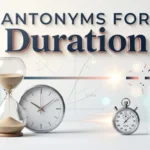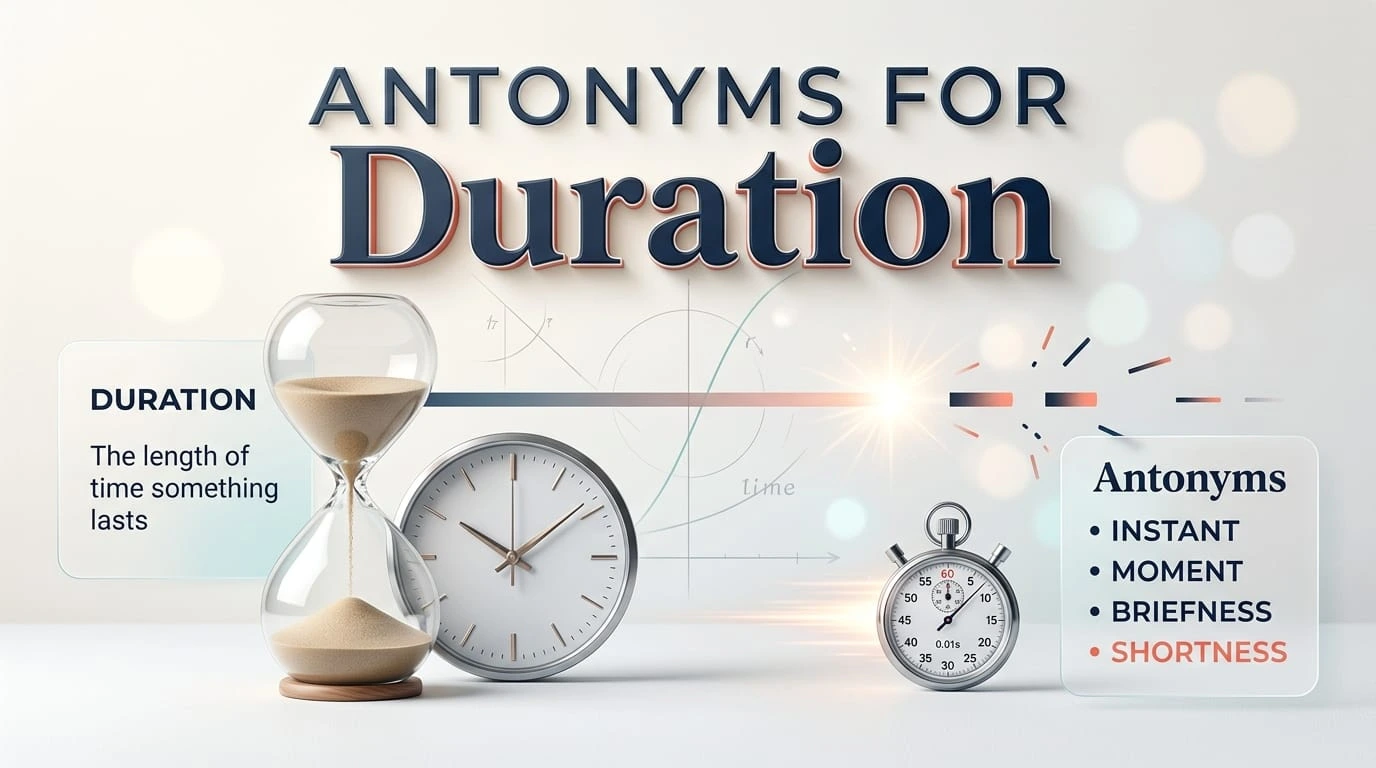
Duration means the length of time something continues, while its opposite refers to a brief, limited, or momentary period.
The Opposite of Duration at a Glance
There is no single universal antonym for duration because duration simply means the length of time something lasts. Depending on context, useful contrasting words include brevity, shortness, moment, instant, and momentariness, especially when emphasizing a very short period or lack of lasting time.
At a Glance
The strongest general contrast to duration is brevity, meaning shortness in time or length.
Other context-dependent opposites include shortness, instant, moment, transience, fleetingness, and momentariness.
Because duration is a neutral noun describing an amount of time, many of these are better described as contextual opposites or contrasting concepts, rather than perfect dictionary antonyms.
Duration and Its Opposite
| Word | Meaning | Example |
| Duration | The length of time something continues | The duration of the meeting was two hours. |
| Brevity | Shortness in time or length | The brevity of the meeting surprised everyone. |
| Moment | A very short period of time | The problem lasted only a moment. |
| Instant | An extremely short period | The screen went dark for an instant. |
| Shortness | The quality of lasting for a short time | The shortness of the visit was disappointing. |
Meaning in Brief
Duration: the amount of time that something lasts or continues.
Main contrasting concept: Brevity the quality of being short in duration or length.
What You’ll Learn
After reading this guide, you will know:
- 20 words that can contrast with duration
- Which words are closest to a true opposite
- How context affects the choice
- How to use these words naturally
20 Words That Contrast With Duration
Because duration does not have one exact opposite, the following words represent different ways of expressing shortness, limited time, or lack of continuation.
1. Brevity
Brevity means shortness in time, speech, writing, or length.
Example:
The brevity of the presentation made it easy to follow.
Best context: General discussions of something being short.
2. Shortness
Shortness refers to the quality of lasting for a limited amount of time.
Example:
The shortness of the ceremony surprised the guests.
Best context: Everyday and general usage.
3. Moment
A moment is a very brief period of time.
Example:
The lights went out for a moment.
Best context: Contrasting a long duration with a brief period.
4. Instant
An instant is an extremely short period of time.
Example:
The screen froze for an instant.
Best context: Very brief events.
5. Second
A second is a very short, precise unit of time.
Example:
The signal disappeared for one second.
Best context: Precise measurement.
6. Minute
A minute can contrast with a long duration when something lasts only a short time.
Example:
The entire inspection took only a minute.
Best context: Everyday time measurement.
7. Brevity
Brevity is the state of being brief or short.
Example:
The brevity of the visit was unexpected.
Best context: Formal or written English.
Note: Brevity is repeated conceptually here because it is the clearest general contrast; it should normally appear only once in an actual word list. For the 20-word set below, use the distinct terms rather than counting duplicate forms.
7. Transience
Transience means the quality of lasting for only a short time.
Example:
The artist explored the transience of human life.
Best context: Formal, literary, or philosophical writing.
8. Fleetingness
Fleetingness describes something that passes very quickly.
Example:
The fleetingness of the opportunity made it difficult to act.
Best context: Literary and descriptive writing.
9. Momentariness
Momentariness means lasting for only a moment or a very short period.
Example:
The momentariness of the interruption caused little concern.
Best context: Formal or academic writing.
10. Ephemerality
Ephemerality refers to the quality of lasting for a very short time.
Example:
The photographer captured the ephemerality of the sunset.
Best context: Formal, artistic, and academic writing.
11. Instantaneity
Instantaneity refers to the quality of happening or occurring instantly.
Example:
The system provides almost complete instantaneity of communication.
Best context: Technical or formal writing.
12. Immediacy
Immediacy emphasizes something happening without delay rather than lasting for a long time.
Example:
The immediacy of the response was more important than its duration.
Best context: Communication, technology, and formal writing.
Important: Immediacy is a contextual contrast, not a direct antonym of duration.
13. Brevity of Time
Brevity of time emphasizes that something occupies only a short period.
Example:
The brevity of time available forced the team to act quickly.
Best context: Formal expressions.
14. Interruption
Interruption refers to a break that stops something from continuing.
Example:
The sudden interruption ended the lecture.
Best context: When duration is contrasted with continuation.
15. Discontinuation
Discontinuation means the ending or stopping of something.
Example:
The discontinuation of the service ended its long duration.
Best context: Business, technical, and formal writing.
16. Cessation
Cessation means the stopping or ending of an activity or process.
Example:
The cessation of rainfall brought relief.
Best context: Formal or academic English.
17. Termination
Termination means bringing something to an end.
Example:
The termination of the contract ended the arrangement.
Best context: Legal, business, and formal contexts.
18. Conclusion
Conclusion refers to the ending of something.
Example:
The conclusion of the event came earlier than expected.
Best context: Events, discussions, processes, and writing.
Note: This is a contextual contrast with continued duration, not a direct antonym.
19. End
End means the point at which something stops.
Example:
The movie finally reached its end.
Best context: Everyday English.
20. Termination Point
A termination point is the point where something stops or comes to an end.
Example:
The process reached its termination point after several hours.
Best context: Technical or formal contexts.
Choosing the Right Antonym
The best contrasting word depends on what you want to express.
When you mean “a short length of time”
Use:
- brevity
- shortness
- moment
- instant
- fleetingness
Example:
The duration of the speech was long.
→ The brevity of the speech made it easier to follow.
When you mean “lasting only briefly”
Use:
- transience
- momentariness
- ephemerality
- fleetingness
These are especially useful in literary, descriptive, and academic writing.
When you mean “stopping or ending”
Use:
- cessation
- termination
- discontinuation
- end
- interruption
These contrast with the idea of something continuing for a duration, but they are not strict antonyms of the noun duration.
How These Contrasting Words Differ
Brevity is the most useful general choice when emphasizing that something lasts for a short time.
Moment and instant describe very short periods rather than qualities of duration.
Transience, fleetingness, and ephemerality emphasize temporary existence.
Cessation, termination, and discontinuation focus on stopping rather than simply being short.
This distinction matters because duration itself is not inherently long or short. It simply describes how long something lasts.
Examples in Context
- The duration of the movie was three hours, while the trailer had remarkable brevity.
- The pain lasted only a moment.
- The system was offline for an instant.
- The transience of the opportunity made it valuable.
- The fleetingness of childhood is a common theme in literature.
- The sudden cessation of the noise surprised everyone.
- The termination of the program brought the project to an end.
- The discontinuation of the service affected many customers.
What Part of Speech Is It?
Duration is a noun.
Examples:
- The duration of the course is six weeks.
- We recorded the duration of the experiment.
Several useful contrasting words are also nouns:
- brevity
- shortness
- moment
- instant
- transience
- fleetingness
- ephemerality
- cessation
- termination
- discontinuation
Some words such as brief and short are adjectives rather than direct noun equivalents.
Commonly Confused Opposites
A frequent mistake is assuming that end is the exact antonym of duration.
❌ The antonym of duration is end.
✅ End can contrast with duration in a particular context because it represents the point at which something stops.
Likewise, brevity is not a perfect dictionary opposite in every situation. It is the most useful contrasting concept when duration is being discussed in terms of length of time.
Usage Tip
Think of duration as answering the question:
“How long does it last?”
Words such as brevity, moment, instant, and fleetingness shift the focus toward how short the period is, while cessation and termination focus on the point at which something stops.
Quick Antonym Quiz
Which word best contrasts with duration when something lasts for only a very short time?
A. Brevity
B. Continuation
C. Extension
Answer: A. Brevity
Brevity means shortness and is the clearest choice when emphasizing a short length of time.
Frequently Asked Questions
What is the opposite of duration?
There is no single exact antonym for duration. Brevity is the closest general contrast when referring to a short length of time.
Is brevity an antonym of duration?
Brevity can function as a contextual antonym of duration when the contrast is between a longer period and something being brief. However, duration itself is neutral and does not specifically mean “long.”
What is a short synonym opposite to duration?
Words such as moment, instant, brevity, shortness, and fleetingness can express the idea of a very short period or limited duration.
Is termination an antonym of duration?
Not directly. Termination means the ending or stopping of something, so it can contrast with the continuation represented by a duration, but it is not a strict lexical antonym.
What is the opposite of long duration?
Depending on the sentence, useful expressions include brevity, short duration, briefness, moment, instant, and a short period.
What to Remember
Duration simply means the length of time something lasts, so it does not have one perfect opposite. Brevity is the clearest general contrast when the focus is shortness. For very brief periods, use moment or instant; for temporary existence, use transience or ephemerality; and for stopping, use cessation or termination.
Antonyms for Vanished: Words for Staying and Appearing

I’m Daniel Carter, a language enthusiast and content writer focused on the fascinating world of antonyms and vocabulary. I break down word meanings and opposites into simple, practical guides helping readers build a richer vocabulary, understand language more deeply, and speak or write with greater confidence.