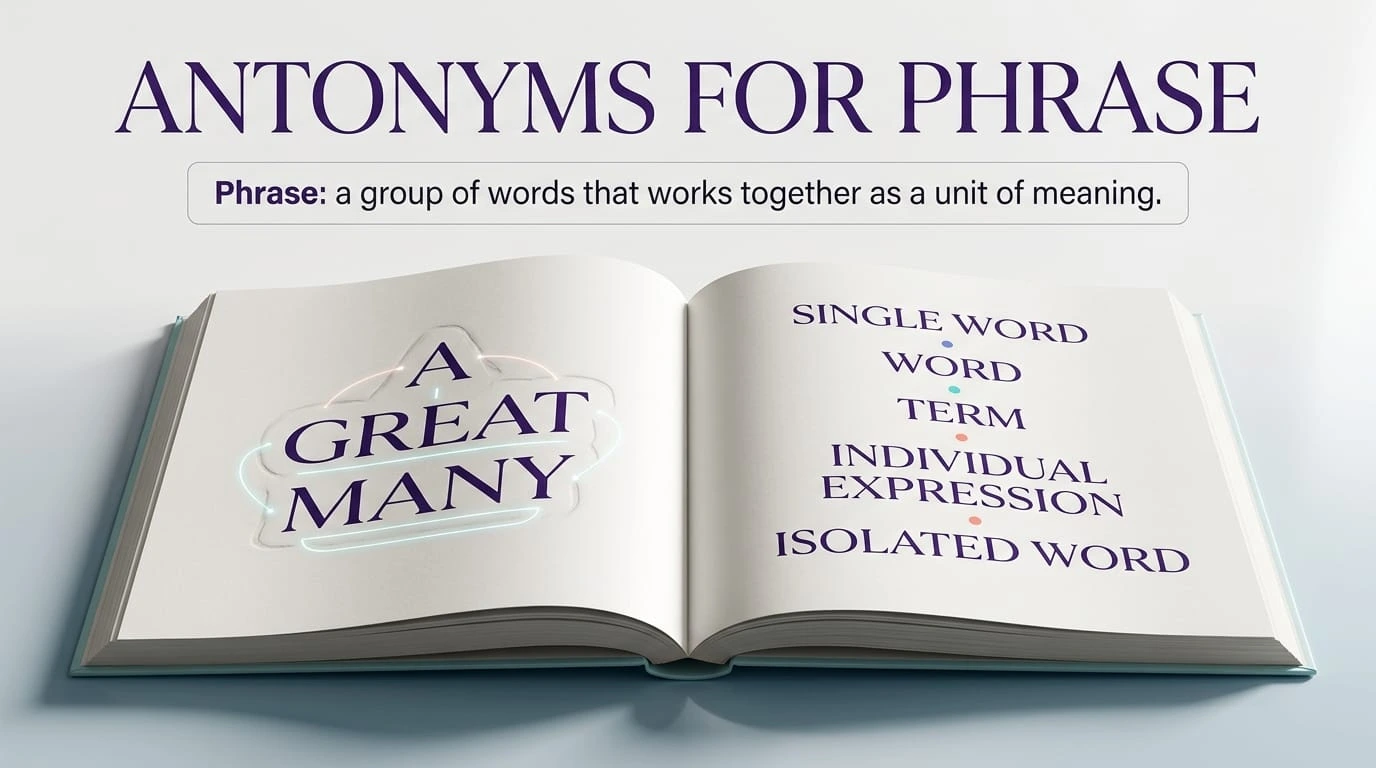
The Opposite of Phrase at a Glance
There is no single standard antonym for phrase. In grammar, a phrase is a group of words that works together as a unit, so useful contrasts may include a single word, silence, or an unexpressed idea, depending on the context. These are contrasts, not universal dictionary antonyms.
Quick Answer
Phrase has no exact, universal antonym. In grammar, a single word can contrast with a phrase because it contains one word rather than a group of words. In communication, silence or an unspoken idea can provide a contextual contrast when phrase means an expressed group of words.
Phrase and Its Contrasts
| Term | Meaning | Example |
| Phrase | A group of words functioning together | “After the meeting” is a phrase. |
| Single word | One word used by itself | “Quickly” is a single word. |
| Clause | A group of words containing a subject and a verb | “She arrived early” is a clause. |
| Sentence | A complete grammatical unit expressing a complete thought | “She arrived early.” |
| Silence | Absence of spoken or written expression | He responded with silence. |
Meaning in Brief
Phrase: A group of two or more words that functions together as a grammatical or meaningful unit.
Main contrast: Single word one word rather than a group of words.
A phrase is not simply the opposite of a word, clause, or sentence. These terms describe different grammatical structures, so they should be treated as contrasting concepts, not strict antonyms.
What You’ll Learn
- Why phrase has no exact antonym
- Which terms contrast with phrase in grammar
- The difference between a phrase, clause, and sentence
- When single word is a useful structural contrast
- Why words such as silence work only in certain communication contexts
Useful Contrasts for Phrase
1. Single Word
A single word consists of one word, while a phrase normally contains multiple words.
Example:
Word: “quickly”
Phrase: “very quickly”
Usage: This is the clearest structural contrast when discussing phrases in grammar.
2. Silence
Silence means the absence of spoken communication.
Example:
Instead of answering with a phrase, she responded with silence.
Important: Silence is a contextual opposite, not a grammatical antonym of phrase.
3. Unspoken Expression
An unspoken expression communicates an idea without using spoken words.
Example:
His facial expression conveyed what he could not put into a phrase.
This contrast is useful when phrase refers to putting an idea into words.
4. Nonverbal Communication
Nonverbal communication conveys meaning without relying primarily on spoken words.
Example:
Her gesture communicated the message without a spoken phrase.
This is a communication-based contrast rather than a strict antonym.
5. Gesture
A gesture is a physical movement used to communicate an idea or feeling.
Example:
He used a gesture instead of a phrase to explain what he wanted.
Again, this is a contextual contrast.
6. Facial Expression
A facial expression communicates emotion or meaning through the face rather than through words.
Example:
Her facial expression said more than any phrase could.
7. Body Language
Body language communicates through posture, movement, and physical behavior.
Example:
His body language communicated discomfort without a single phrase.
8. Action
An action can communicate an idea through behavior instead of words.
Example:
Her actions showed gratitude without a spoken phrase.
Different Meanings, Different Contrasts
The word phrase can be used in several related ways, so the appropriate contrast changes with the context.
When Phrase Means a Grammatical Unit
In grammar, a phrase is a group of words functioning together.
Useful structural contrasts include:
- Single word
- Clause
- Sentence
However, these are not exact antonyms. A clause and sentence are larger or structurally different grammatical units rather than opposites.
Example:
“in the morning” phrase
“she arrived” clause
“Morning.” single word
When Phrase Means an Expressed Group of Words
When phrase refers to wording used to express something, communication-based contrasts can include:
- Silence
- Gesture
- Facial expression
- Body language
- Action
- Nonverbal communication
These represent ways of communicating without using the same type of verbal expression.
How These Contrasts Differ
Phrase vs. Single Word
A phrase contains multiple words working together, while a single word contains only one lexical item.
Single word: “carefully”
Phrase: “with great care”
This is a structural contrast, not a true antonym.
Phrase vs. Clause
A phrase does not normally contain a complete subject–verb relationship, whereas a clause contains a subject and a predicate.
Phrase: “after lunch”
Clause: “after we ate lunch”
A clause is therefore not an opposite of a phrase.
Phrase vs. Sentence
A sentence is a complete grammatical unit that can express a complete thought. A phrase is normally only part of a larger structure.
Phrase: “in the garden”
Sentence: “The children played in the garden.”
They differ in grammatical function rather than opposite meaning.
Phrase vs. Silence
These contrast more naturally in communication.
She answered with a phrase.
He answered with silence.
Here, silence represents an absence of verbal response.
Phrase in Context
Grammar
“under the old bridge” is a prepositional phrase.
Everyday Speech
“Take care” is a common phrase.
Written Expression
The writer used a short phrase to summarize the idea.
Communication
He gave no verbal phrase in response and remained silent.
These examples show why the meaning of phrase matters when looking for a contrasting concept.
Examples in Context
- The answer was expressed in a phrase, not a single word.
- She responded with silence instead of a verbal phrase.
- The writer replaced the long phrase with a single word.
- “Because she was tired” is a clause, not merely a phrase.
- His gesture communicated the message without words.
- Her facial expression conveyed what she could not express in a phrase.
- The child’s action communicated gratitude without a spoken response.
What Part of Speech Is It?
Phrase is primarily a noun when referring to a group of words or an expression.
Examples:
- That is a common phrase.
- The sentence contains a prepositional phrase.
It can also occur in the verb phrase, meaning to express or word something in a particular way.
Example:
The editor phrased the question carefully.
The grammatical noun phrase should not be confused with its related verb form.
Commonly Confused Concepts
A Phrase Is Not the Opposite of a Word
A word and a phrase are different linguistic units.
A word can sometimes communicate an idea that would otherwise require a phrase, but that does not make word the strict antonym of phrase.
A Clause Is Not an Antonym of Phrase
A clause and phrase are different grammatical structures.
Phrase: “after the class”
Clause: “after the class ended”
The clause contains a subject and verb relationship; the phrase does not.
A Sentence Is Not an Antonym of Phrase
A sentence may contain one or more phrases.
The sentence “The boy ran across the field” contains several grammatical components, including phrases.
Therefore, sentence is a related grammatical term, not an antonym.
Common Errors to Avoid
❌ Incorrect: “Silence is the dictionary antonym of phrase.”
✅ Better: “Silence can be a contextual contrast to phrase in communication.”
❌ Incorrect: “Clause is the opposite of phrase.”
✅ Better: “A clause is a different grammatical unit from a phrase.”
❌ Incorrect: “Word is always the antonym of phrase.”
✅ Better: “A single word can provide a useful structural contrast to a phrase.”
A Useful Language Tip
When searching for an antonym of a grammatical term, first determine whether the word describes a meaning or a linguistic structure.
Words describing structures often do not have true antonyms. Instead, they have contrasting grammatical categories.
For phrase, single word is often the clearest structural contrast, while silence is useful only when discussing verbal communication.
Quick Practice
Which option is a grammatical contrast to a phrase?
A. Silence
B. Single word
C. Happiness
Answer: B. Single word
A single word and a phrase are different linguistic units. Silence can contrast with a phrase in communication, but it is not a grammatical antonym.
Frequently Asked Questions
What is the antonym of phrase?
There is no single standard antonym for phrase. In grammar, single word can be a useful structural contrast, while silence or nonverbal communication may contrast with a phrase in certain communication contexts.
Is word the opposite of phrase?
Not exactly. A word and a phrase are different linguistic units. A single word can be contrasted with a phrase because a phrase consists of multiple words, but word is not a strict antonym.
Is clause the opposite of phrase?
No. A clause and a phrase are different grammatical structures. A clause generally contains a subject and a predicate, while a phrase functions as a unit without forming a complete clause.
Is sentence the opposite of phrase?
No. A sentence and a phrase serve different grammatical functions. A sentence can contain phrases, so they are not opposites.
Can silence be an antonym of phrase?
Only contextually. If phrase means a spoken verbal expression, silence can represent the absence of verbal communication. It is not a universal antonym of phrase.
What to Remember
Phrase has no exact universal antonym. The best contrast depends on the meaning:
- Single word → structural contrast in grammar
- Clause → different grammatical unit
- Sentence → larger grammatical unit
- Silence → contextual contrast in communication
- Gesture / body language → nonverbal communication contrasts
The safest approach is to call these contrasts or related grammatical concepts, rather than claiming they are all strict antonyms.
Synonyms and Antonyms for Explicit

I’m Daniel Carter, a language enthusiast and content writer focused on the fascinating world of antonyms and vocabulary. I break down word meanings and opposites into simple, practical guides helping readers build a richer vocabulary, understand language more deeply, and speak or write with greater confidence.