The Opposite of Arbitrary at a Glance
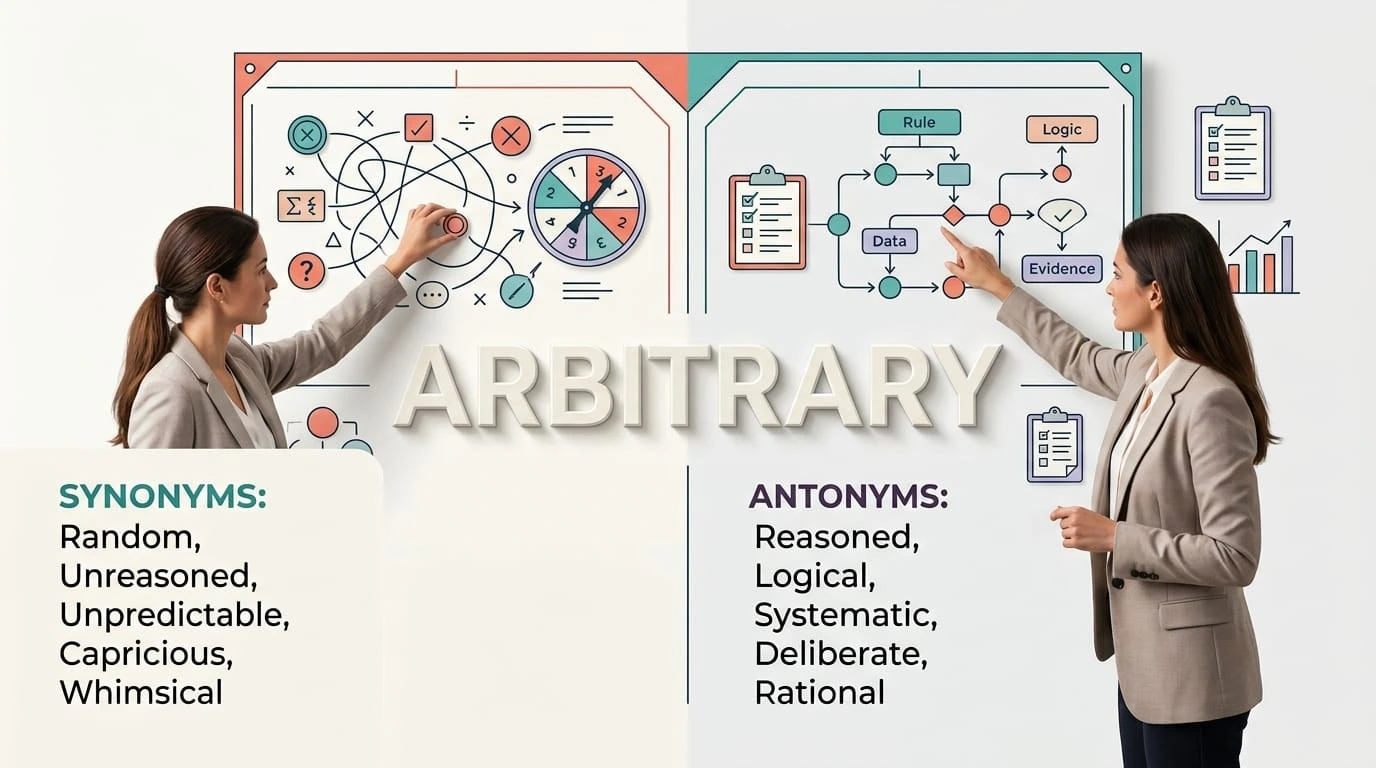
The strongest antonyms for arbitrary are deliberate, reasoned, systematic, justified, and principled, depending on context. Arbitrary can describe something chosen without a clear reason, based on personal preference, or lacking a consistent rule. Its opposite therefore suggests planning, logic, fairness, or a clear basis for a decision.
At a Glance
The word arbitrary usually describes something decided without a clear, logical, or consistent reason. It can also mean random, unrestricted, or based on personal preference rather than an established rule.
For example:
- Arbitrary decision → a decision made without a clear reason or consistent standard
- Arbitrary choice → a choice made freely or without a particular basis
- Arbitrary number → a number selected without a specific reason
- Arbitrary rule → a rule that may seem imposed without logical justification
Because the meaning changes slightly with context, its synonyms and antonyms also vary.
Quick Word Comparison
| Word | Meaning | Example |
| Arbitrary | Based on personal choice, chance, or no clear reason | The rule seemed arbitrary. |
| Reasoned | Based on logic and careful thought | The committee made a reasoned decision. |
| Random | Chosen without a predictable pattern | She selected a random number. |
| Systematic | Following an organized method or system | The researcher used a systematic approach. |
The Meaning of Arbitrary
Arbitrary: decided or chosen without a clear reason, rule, or consistent principle.
Main antonym: reasoned based on logic, evidence, or careful thought.
The exact opposite depends on what arbitrary means in the sentence.
What You’ll Learn
After reading this guide, you will know:
- Common synonyms for arbitrary
- Accurate antonyms for arbitrary
- How the meaning of arbitrary changes with context
- Which synonyms and antonyms work best in formal and everyday English
- How to use these words naturally in sentences
Useful Synonyms to Know
The best synonym for arbitrary depends on the intended meaning.
1. Random
Random means selected without a specific pattern, plan, or reason.
Example:
The computer generated a random number.
Best used when: arbitrary means something selected by chance.
2. Haphazard
Haphazard describes something done without organization, planning, or order.
Example:
The books were placed in a haphazard manner.
Best used when: the emphasis is on disorder or lack of planning.
3. Capricious
Capricious means changing suddenly according to unpredictable personal feelings or preferences.
Example:
The manager’s capricious decisions made the employees uneasy.
Best used when: an arbitrary decision is unpredictable or driven by changing personal preferences.
4. Unreasoned
Unreasoned means not supported by logical thought or good reasons.
Example:
His unreasoned objection prevented the proposal from moving forward.
Best used when: arbitrary means lacking a rational basis.
5. Unsystematic
Unsystematic means not following an organized or consistent method.
Example:
The researcher rejected the unsystematic approach.
Best used when: the focus is on a lack of method or consistency.
6. Haphazardly Chosen
This expression describes something selected without careful planning or a clear method.
Example:
The participants were haphazardly chosen from the available group.
7. Whimsical
Whimsical can describe something based on a playful or unusual personal idea rather than practical reasoning.
Example:
The designer made a whimsical choice of colors.
Note: Whimsical is not always negative, so it is only a contextual synonym for arbitrary.
8. Discretionary
Discretionary means determined according to someone’s judgment or choice rather than being automatically required.
Example:
The manager has discretionary authority over the budget.
Note: This is a contextual synonym, not a perfect replacement. Discretionary can be neutral or positive, while arbitrary often suggests a lack of justification.
Common Opposites of Arbitrary
There is no single antonym that works perfectly in every sentence. The most useful opposites include reasoned, deliberate, systematic, justified, principled, rational, consistent, objective, and planned.
1. Reasoned
Reasoned means based on logic, evidence, and careful thought.
Example:
The panel reached a reasoned conclusion after reviewing the evidence.
This is one of the strongest antonyms when arbitrary means without logical justification.
2. Deliberate
Deliberate means carefully considered and intentionally done.
Example:
The change was a deliberate decision made after several meetings.
Use it when arbitrary means unplanned or accidental.
3. Systematic
Systematic means following an organized and consistent method.
Example:
The team conducted a systematic review of the available data.
This is especially useful when arbitrary refers to a lack of order or method.
4. Justified
Justified means supported by good reasons or evidence.
Example:
The committee believed that the decision was justified by the evidence.
This is a strong opposite when an arbitrary decision lacks a defensible reason.
5. Principled
Principled means guided by clear moral, ethical, or consistent standards.
Example:
She took a principled position on the issue.
Use this when arbitrary suggests unfair or inconsistent decision-making.
6. Rational
Rational means based on reason and logical thinking.
Example:
We need a rational explanation for the change.
It contrasts with an arbitrary decision that lacks logical support.
7. Consistent
Consistent means following the same standard, pattern, or principle.
Example:
The school needs a consistent policy for handling complaints.
This is particularly useful when arbitrary means inconsistent or unpredictable.
8. Objective
Objective means based on facts rather than personal feelings or preferences.
Example:
The evaluation should be objective and evidence-based.
This is a useful antonym when arbitrary suggests personal bias.
9. Planned
Planned means arranged or decided in advance.
Example:
The event was carefully planned several weeks ahead.
Use it when arbitrary means unplanned or spontaneous.
10. Regulated
Regulated means controlled by established rules or standards.
Example:
The industry operates under a regulated system.
This works when arbitrary refers to something unrestricted or lacking established rules.
Choosing the Right Antonym
The correct opposite depends on the meaning of arbitrary.
When Arbitrary Means “Without Reason”
Use:
- Reasoned
- Rational
- Justified
- Logical
- Principled
Example:
The punishment seemed arbitrary.
Better opposite:
The punishment was justified by the seriousness of the offense.
When Arbitrary Means “Unplanned or Random”
Use:
- Deliberate
- Planned
- Intentional
- Systematic
- Organized
Example:
The numbers were selected arbitrarily.
Opposite:
The numbers were deliberately selected according to a fixed method.
When Arbitrary Means “Based on Personal Preference”
Use:
- Objective
- Impartial
- Principled
- Evidence-based
- Consistent
Example:
The hiring process appeared arbitrary.
Opposite:
The hiring process was objective and consistent.
How These Words Differ
Not every synonym or antonym of arbitrary can replace the word in every sentence.
Random focuses on chance.
Haphazard focuses on disorder or lack of planning.
Capricious focuses on unpredictable personal decisions.
Reasoned focuses on logic.
Justified focuses on having sufficient reasons or evidence.
Systematic focuses on following an organized method.
Objective focuses on avoiding personal bias.
Principled focuses on following clear standards or values.
For example, random is a better opposite of deliberately selected than objective is, while objective is a better contrast when arbitrary describes a biased decision.
See the Antonyms in Action
Arbitrary vs. Reasoned
Arbitrary:
The committee made an arbitrary decision without explaining its reasoning.
Reasoned:
The committee made a reasoned decision after reviewing the evidence.
Arbitrary vs. Deliberate
Arbitrary:
The number was chosen arbitrarily.
Deliberate:
The number was deliberately selected for a specific purpose.
Arbitrary vs. Systematic
Arbitrary:
The samples were collected using an arbitrary method.
Systematic:
The samples were collected using a systematic method.
Arbitrary vs. Justified
Arbitrary:
The employee felt that the disciplinary action was arbitrary.
Justified:
The supervisor explained why the disciplinary action was justified.
Arbitrary vs. Objective
Arbitrary:
The selection process appeared arbitrary.
Objective:
The selection process used objective criteria.
What Part of Speech Is It?
Arbitrary is primarily an adjective.
Examples:
- an arbitrary decision
- an arbitrary rule
- an arbitrary choice
- an arbitrary number
Most of its useful antonyms in this context are also adjectives:
- reasoned
- deliberate
- systematic
- justified
- rational
- principled
- consistent
- objective
- planned
The noun arbitrariness refers to the quality of being arbitrary.
Example:
The arbitrariness of the rule caused confusion.
Commonly Confused Opposites
Random vs. Arbitrary
These words overlap, but they are not identical.
Random usually emphasizes chance or the absence of a predictable pattern.
Arbitrary can emphasize a choice made without a clear reason, standard, or justification.
For example:
The computer generated a random number.
But:
The manager imposed an arbitrary rule.
The first concerns chance; the second suggests a questionable basis for a decision.
Deliberate vs. Arbitrary
These can be opposites in some contexts, but not always.
Something can be deliberate and arbitrary if someone intentionally makes a choice without a reasonable basis.
For example:
The manager deliberately introduced an arbitrary restriction.
Therefore, deliberate is not a universal antonym of arbitrary.
A Useful Language Tip
When describing a decision, rule, judgment, or policy, avoid automatically using random as the opposite of arbitrary. If you mean that the decision has a logical basis, reasoned, justified, or principled may be much more precise.
Quick Antonym Quiz
1. Which word best describes a decision supported by logic and careful thought?
A. Random
B. Reasoned
C. Haphazard
Answer: B. Reasoned
A reasoned decision is based on logic and careful consideration.
2. Which word best contrasts with an arbitrary system that lacks an organized method?
A. Systematic
B. Capricious
C. Whimsical
Answer: A. Systematic
A systematic approach follows an organized method.
Frequently Asked Questions
What is the most common synonym of arbitrary?
A common synonym is random, especially when arbitrary means selected without a specific pattern or reason. Other contextual synonyms include haphazard, capricious, unreasoned, and unsystematic.
What is the best antonym for arbitrary?
There is no single best antonym for every context. Reasoned is a strong choice when arbitrary means lacking logical support. Systematic, justified, principled, and objective may be better in other contexts.
Is random always a synonym of arbitrary?
No. Random emphasizes chance or unpredictability, while arbitrary can also describe a decision made according to personal choice without a clear or fair basis.
Is deliberate the opposite of arbitrary?
Sometimes, but not always. Something can be deliberate while still being arbitrary. If you want to express the opposite of an arbitrary decision, reasoned, justified, principled, or objective may be more accurate.
What is the opposite of arbitrary in formal writing?
Depending on the context, strong formal alternatives include reasoned, justified, systematic, objective, principled, rational, and consistent.
Key Takeaways
- Arbitrary can mean random, unplanned, or based on personal choice without a clear reason.
- Useful synonyms include random, haphazard, capricious, unreasoned, and unsystematic.
- Strong contextual antonyms include reasoned, justified, systematic, deliberate, principled, rational, consistent, and objective.
- Reasoned is especially useful when the opposite involves logic.
- Systematic works well when the contrast involves method and organization.
- Objective is useful when the contrast involves personal bias or preference.
- No single antonym works perfectly in every context.
Antonyms for Option: Opposites Explained Clearly

I’m Daniel Carter, a language enthusiast and content writer focused on the fascinating world of antonyms and vocabulary. I break down word meanings and opposites into simple, practical guides helping readers build a richer vocabulary, understand language more deeply, and speak or write with greater confidence.