What is the opposite of rural?
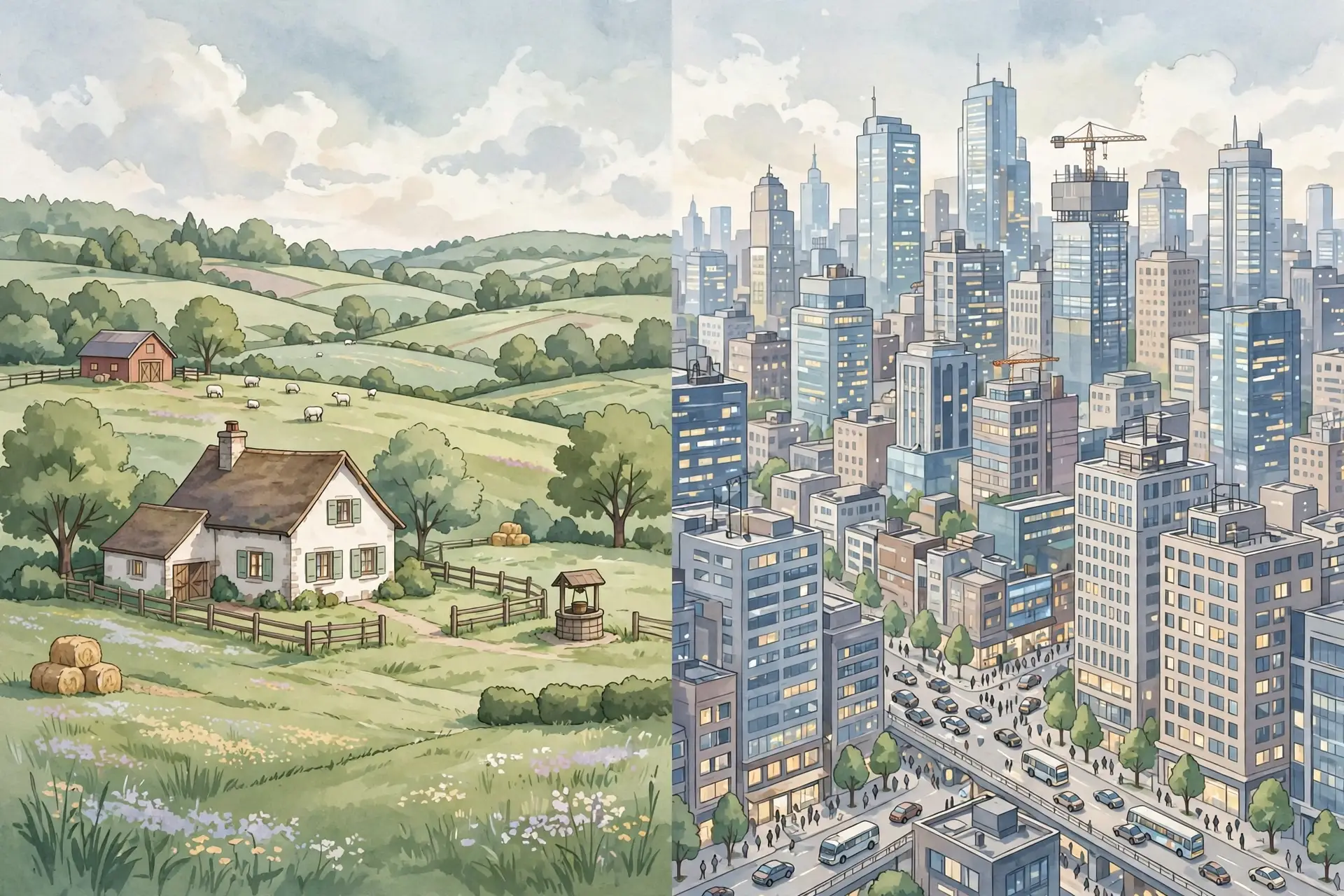
The opposite of rural is urban or city life in towns and cities instead of the countryside. Words like metropolitan, cosmopolitan, and industrial mark the built-up, busy world, where rural marks open land, farms, and small villages.
What Rural Means in Plain Words
The most common antonym of rural is urban. Rural means of or relating to the country, country people or life, or agriculture: rural areas, rural schools, rural roads. Its opposite is the city: urban streets, city crowds, metropolitan life. Urban is the direct opposite, the town against the country, while metropolitan is the grander one, the big city with its districts and suburbs. Suburban sits in between, the edge of the city where houses replace fields.
Rural Against Its Opposites
| Word | Meaning | Example |
|---|---|---|
| Rural | Of the country, farming, or village life | She grew up in a rural village. |
| Urban | Of towns and cities | Urban life moves at a fast pace. |
| City | Of a large town or its centre | City streets were crowded with buses. |
| Metropolitan | Of a large city and its area | The metropolitan region has ten million people. |
| Suburban | Of the outskirts of a city | They bought a suburban house with a garden. |
Rural in One Line
Of or relating to the country, country people or life, or agriculture.
Main antonym: Urban of or relating to towns and cities.
For the full dictionary entry, see rural on Merriam-Webster.
What This Guide Covers
After reading this guide, you will know:
- The main antonym of rural
- Ten useful opposites and when each one fits
- How rural differs from urban
- How to use these words correctly in sentences
Ten Opposites of Rural
1. Urban (adjective)
Meaning: Of or relating to towns and cities, the direct opposite of rural.
Examples:
- Urban life moves at a fast pace.
- Urban schools have hundreds of students.
2. City (adjective)
Meaning: Of a large town, used before a noun to mean city life or city things.
Examples:
- City streets were crowded with buses.
- She missed the city lights after moving away.
3. Metropolitan (adjective)
Meaning: Of a large city and the area around it.
Examples:
- The metropolitan region has ten million people.
- Metropolitan trains run all night.
4. Cosmopolitan (adjective)
Meaning: Full of people from many countries and cultures, like a world city.
Examples:
- London is a cosmopolitan city.
- The cosmopolitan crowd spoke a dozen languages.
5. Municipal (adjective)
Meaning: Of a town or city and its local government.
Examples:
- Municipal workers repaired the road.
- The municipal library opens every morning.
6. Suburban (adjective)
Meaning: Of the outskirts of a city, where houses and gardens replace farms.
Examples:
- They bought a suburban house with a garden.
- Suburban trains carry workers into the city.
7. Downtown (adjective)
Meaning: Of the central business part of a city.
Examples:
- Downtown shops stay open late.
- The downtown office tower is forty floors high.
8. Industrial (adjective)
Meaning: Of factories, manufacturing, and industry rather than farming.
Examples:
- The industrial town grew around the steel works.
- Industrial areas have warehouses, not wheat fields.
9. Developed (adjective)
Meaning: Built up with roads, buildings, and services, the opposite of open countryside.
Examples:
- The developed district has hospitals and malls.
- Developed land costs far more than farmland.
10. Modern (adjective)
Meaning: New, up to date, and built in the present style, unlike old country ways.
Examples:
- Modern flats rose where the old farm stood.
- The village got a modern clinic last year.
Picking the Right Opposite
Rural wears several meanings, and each one takes a different opposite.
If rural means the countryside itself, use urban or city. These name the town against the country. “Urban life moves at a fast pace.”
If rural means a large city and its whole area, use metropolitan. It covers the city plus its suburbs. “The metropolitan region has ten million people.”
If rural means farming and agriculture, use industrial. It names factories and manufacturing against fields. “The industrial town grew around the steel works.”
If rural means the edge between country and city, use suburban. It describes the in-between zone. “They bought a suburban house with a garden.”
Rural in Real Sentences
- In daily life: “She left her rural village for an urban job in the city.”
- At school: “The rural school had fifty pupils; the city school had a thousand.”
- In the news: “Rural roads flooded, while metropolitan trains kept running.”
- In a story: “He missed the quiet rural lanes and hated the downtown noise.”
- In business: “The company moved its factory from a rural site to an industrial park.”
- In conversation: “Life is slow in a rural town and fast in a cosmopolitan city.”
Rural or Urban?
They are the classic pair, and writers mix them up less than they misuse them. Rural means of the country: farms, villages, open land. Urban means of the town: streets, flats, offices. The overlap comes with suburbs and small towns: a town of ten thousand people feels rural to a city person and urban to a farmer. When the place has farms and fields, rural is the word. When it has streets and towers, urban fits better. The pair comes from Latin itself: rural from rus, open land, and urban from urbs, city. The two words were born as opposites.
Using Rural Correctly
Rural is an adjective. It describes a noun: rural areas, rural life, rural schools. Its noun form is rurality, meaning the quality of being rural. Its useful opposites are adjectives too: urban, metropolitan, suburban, and industrial. Watch out for rurban, a rare blend of rural and urban, meaning an area that is chiefly residential but where some farming goes on. It is a real word, but it is rare, so use it only when you mean the blend. Rural never takes an -ly adverb form in normal use: say “in a rural way” or “rurally” only in formal writing, and prefer the plain phrase.
Mistakes Writers Make
- ❌ Incorrect: “The rural city has tall towers.” ✅ Correct: “The urban city has tall towers.” Rural means countryside, so it cannot describe a city of towers.
- ❌ Incorrect: “She lives in an urban farm.” ✅ Correct: “She lives on a rural farm.” A farm belongs to the country, so rural fits.
- ❌ Incorrect: “The suburban village is miles from any town.” ✅ Correct: “The rural village is miles from any town.” Suburban means near a city, so it cannot describe a far-off village.
- ❌ Incorrect: “Rural and urban mean the same thing.” ✅ Correct: “Rural means country, and urban means city.” They are opposites, not twins.
Check What You Know
- Choose the correct antonym: “They moved from a ___ village to a busy city flat.” A. rural B. urban C. pastoral — Answer: A. rural, because the village is in the country.
- Fill in the blank: “The ___ region has ten million people and trains all night.” — Answer: metropolitan, the word for a large city and its area.
- True or false: “Suburban means far from any city.” — False. Suburban means on the outskirts of a city, close enough to travel in daily.
Your Rural Questions, Answered
What is the opposite of rural?
The most common opposite of rural is urban or city — life in towns and cities instead of the countryside.
What is a stronger opposite of rural?
Metropolitan and cosmopolitan are stronger than urban, because they mean a large, worldly city with many people and cultures, not just any town.
Can “urban” always replace the opposite of rural?
No. Urban fits towns and cities in general, but metropolitan fits a large city region, industrial fits factory areas, and suburban fits the outskirts, so the specific word is usually better.
What is the difference between rural and urban?
Rural means of the country: farms, villages, and open land. Urban means of the town: streets, flats, and offices. Rural comes from Latin rus, open land; urban comes from Latin urbs, city.
Is rural appropriate in formal writing?
Yes. Rural is a standard word in geography, planning, news, and academic writing, and it suits formal and informal contexts alike.
Rural, Wrapped Up
The opposite of rural depends on the sense: urban and city answer the town, metropolitan and cosmopolitan answer the big city, and industrial answers farming. Keep rural for the country and urban for the town, remember that rural comes from Latin rus and urban from Latin urbs, and you will choose the right opposite every time.

I’m Daniel Carter, a language enthusiast and content writer focused on the fascinating world of antonyms and vocabulary. I break down word meanings and opposites into simple, practical guides helping readers build a richer vocabulary, understand language more deeply, and speak or write with greater confidence.