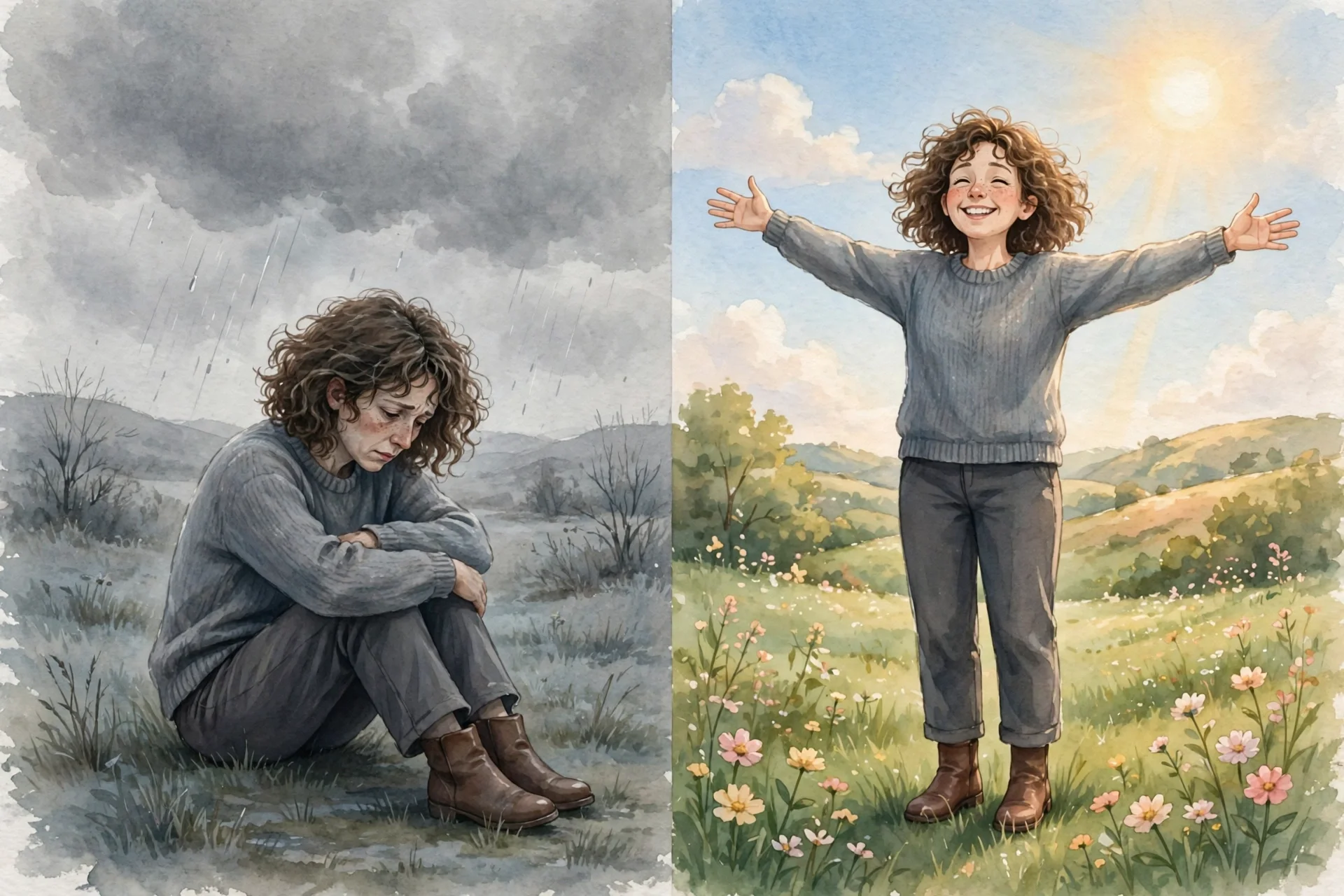
The opposite of depression is happiness, joy, or elation when the word means a low mood. In economics, the opposite is a boom or prosperity, and in geography, the opposite is a hill or elevation. The antonym depends on which sense of depression you mean, so check the context first.
What Does Depression Mean?
Depression is a noun with several meanings, and the most common one in everyday speech is a state of feeling sad, a sinking of the spirits that lasts longer than a passing bad mood. When someone says they feel a sense of depression, they usually mean a heavy, low feeling that stays with them for days or weeks, not a single sad moment.
Merriam-Webster lists the main senses of the word, and you can read the full entry for depression on Merriam-Webster. The dictionary gives the mood sense first, then the economic sense, then the sense of a low place or hollow in the ground. All three share the same root idea: something pressed down, whether it is a mood, trade, or the land itself.
Here are two examples of the word in its most common sense:
- “After the move to a new city, a quiet depression settled over her, and even her favourite songs sounded flat.”
- “He described the winter as a season of depression, when the short days left him tired and low.”
The connotation of depression is negative in the mood sense, because it points to sadness and low energy, and negative in the economic sense, since it describes hard times for trade and jobs. In the geographic sense it is neutral, because a depression in the ground is simply a low area.
The Origin of Depression: Where the Word Comes From
Depression comes from Old French depression, which came from Medieval Latin depressio, a noun built from the Latin verb deprimere, meaning to press down. That verb joins de, meaning down, with premere, meaning to press. The word entered English in the 14th century, first as a term in astronomy for the angular distance of a star below the horizon.
The sense of dejection, a sinking of the spirits, is recorded from the early 15th century, and Merriam-Webster gives the first known use of depression in the 15th century. The literal sense, the act of pressing down, is attested from the 1650s. The economic sense was in use by 1826, and the Great Depression of the 1930s gave the word its famous capital D form. The weather sense dates from 1881, and the clinical use in psychology dates from 1905.
The pronunciation is /dɪˈprɛʃən/, with three syllables, de-pres-sion, and the stress on the second syllable.
Depression in Everyday Language: Three Meanings to Know
Most people meet depression in one of three senses, and the right antonym changes with each one.
1. The mood sense. This is the everyday meaning: a state of feeling sad and low, with little energy or interest. The opposites here are words like happiness, joy, and elation.
2. The economic sense. In economics, a depression is a long period of greatly reduced activity, with falling trade, closed businesses, and rising unemployment. The Great Depression of the 1930s is the best known example, and the opposites here are boom, prosperity, and recovery.
3. The geographic sense. In geography, a depression is a place or part that is lower than the surrounding area, a hollow in the ground. A valley floor or a sinkhole can be called a depression, and the opposites here are hill, rise, and elevation.
Knowing which sense is in play is the first step in choosing the right opposite, because an antonym that fits one sense will sound wrong in another.
Depression or Happiness? How the Opposite Works
Happiness is the most natural opposite of depression when the word means a low mood. The two words sit at opposite ends of the same scale: depression is a heavy, flat, low feeling, while happiness is a light, warm, lifted feeling.
The match works because both words describe a general state rather than a single moment. A person can feel happy for an afternoon and sad for an afternoon, but depression and happiness both suggest something that lasts longer and colours the whole day. That is why writers reach for happiness first when they need the opposite of depression.
Other opposites add their own shade. Joy is stronger and brighter than happiness. Elation adds excitement after a success. Contentment is quieter and calmer. Optimism looks forward, while hope holds on through hard times. Each one fits a different sentence.
10 Antonyms for Depression With Meanings and Examples
1. Happiness (noun)
Meaning: A state of feeling pleased and content with life.
Examples:
– “Her happiness was clear in the way she smiled at everyone she met.”
– “He found happiness in simple things, like morning walks and good books.”
2. Joy (noun)
Meaning: A strong feeling of great pleasure and gladness.
Examples:
– “The children’s joy filled the room when they saw the surprise party.”
– “She felt pure joy when her name was called as the winner.”
3. Elation (noun)
Meaning: A feeling of great happiness and excitement, often after a success.
Examples:
– “Elation swept through the team when the final whistle blew.”
– “He could not hide his elation after passing the exam.”
4. Cheerfulness (noun)
Meaning: A bright, happy quality that lifts the mood of other people too.
Examples:
– “Her cheerfulness made even dull mornings feel light.”
– “The teacher’s cheerfulness kept the class engaged all day.”
5. Contentment (noun)
Meaning: A calm, quiet sense of being satisfied with what you have.
Examples:
– “After years of hard work, he finally felt contentment in his small garden.”
– “Contentment is not about having more, but about wanting less.”
6. Optimism (noun)
Meaning: A hopeful way of looking at life, expecting good things to happen.
Examples:
– “Her optimism helped the whole group stay calm during the long delay.”
– “Optimism does not ignore problems, it believes they can be solved.”
7. Hope (noun)
Meaning: A feeling that what you want will happen, or that things will get better.
Examples:
– “Hope kept her going through the long winter.”
– “The letter brought hope to the whole family.”
8. Delight (noun)
Meaning: Great pleasure and joy, often from something pleasant and unexpected.
Examples:
– “To his delight, the old shop had kept his favourite sweets.”
– “The baby laughed with delight at the colourful balloons.”
9. Excitement (noun)
Meaning: A feeling of eager enthusiasm and lively interest.
Examples:
– “Excitement filled the hall before the concert began.”
– “She could not sleep the night before the trip, such was her excitement.”
10. Euphoria (noun)
Meaning: A very strong feeling of happiness and well being, often sudden and intense.
Examples:
– “A wave of euphoria followed the news of the win.”
– “The climbers felt euphoria as they reached the summit at sunrise.”
Depression vs Joy: A Side by Side Comparison
Depression and joy are strong opposites, and a side by side look shows how far apart they sit.
| Feature | Depression | Joy |
|---|---|---|
| Core meaning | A low, heavy mood that lasts | A strong feeling of great pleasure |
| Feeling | Sad, flat, tired | Bright, warm, lifted |
| Energy | Low, slow, drained | High, lively, eager |
| Outlook | Things look bleak and heavy | Things look good and hopeful |
| Example | “A depression hung over the house all week.” | “Joy filled the house when the results came in.” |
Joy is the strongest simple opposite for everyday writing, because it matches depression in strength. Happiness is gentler and more general, while joy carries the same weight as depression, only in the other direction. When the sentence needs a big contrast, joy is the better pick.
When Depression Means Something Else: Economy and Land
Not every use of depression is about mood, and the antonym must change when the sense changes.
In economics, a depression is a long slump in trade, with closed shops, lost jobs, and falling prices. The opposite is a boom, a period when trade grows fast and jobs are easy to find. Prosperity and recovery also work, and a sentence like “the boom that followed the depression” uses the pair exactly as economists do.
In geography, a depression is a hollow, a part of the land that sits lower than the ground around it. The opposite is a hill, a rise, or an elevation, as in “the path climbed from the depression to the ridge.” In this sense, happiness would be nonsense as an opposite, which is why the context always comes first.
Common Mistakes With Depression and Its Antonyms
Mistake 1: Using “happy” as the opposite noun.
Happy is an adjective, while depression is a noun. The correct noun opposite is happiness. Write “happiness replaced the depression” rather than “happy replaced the depression.”
Mistake 2: Confusing depression with sadness.
Sadness is a normal feeling that passes, often after a clear cause. Depression, in everyday language, is a deeper and longer low mood. Use sadness for a short feeling and depression for a heavier, lasting one.
Mistake 3: Using a mood antonym for the economic sense.
Happiness is not the opposite of an economic depression. In a sentence about trade, use boom, prosperity, or recovery instead.
Mistake 4: Using a mood antonym for the geographic sense.
Joy cannot describe land. For a hollow in the ground, use hill, rise, or elevation as the opposite.
Mistake 5: Reaching for “mania” as the opposite.
Mania is a different clinical state, not a safe everyday opposite for depression. In normal writing, use joy, happiness, or elation instead.
Depression in Real Life: Examples From Everyday Writing
Writers use depression and its opposites in stories, essays, diaries, and news, and the context always shapes the choice.
In a story, the pair can carry a whole scene: “The depression that had hung over the village all winter lifted in a single morning, and joy ran through the streets like sunlight.” The contrast works because the two words are equal in weight.
In a diary, the pair is quieter: “I wrote that the depression was easing, and for the first time in weeks I felt something close to contentment.” Here contentment fits better than joy, because the change is small and calm.
In a school essay, the pair can be plain and clear: “Depression means a long low mood, while happiness means a settled sense of pleasure and ease.”
In news writing about the economy, the pair changes completely: “After years of depression in the steel towns, a modest boom brought new jobs to the region.” Here boom is the right opposite, and happiness would be wrong.
How to Choose the Right Antonym for Depression
Choosing the right opposite takes three quick checks.
First, check the sense. Ask whether the sentence is about mood, money, or land. Mood takes happiness or joy, money takes boom or prosperity, and land takes hill or elevation.
Second, check the part of speech. Depression is a noun, so its opposite should be a noun too. Happiness, joy, elation, and hope are all nouns, which keeps the sentence smooth.
Third, match the strength. A mild low mood pairs well with contentment or cheerfulness, a deep low mood with joy or euphoria, and a sudden lift after bad news with elation or delight.
When all three checks agree, the antonym will sound natural, and the reader will not have to stop and think.
Depression in Idioms and Common Phrases
English has many idioms on both sides of this pair. On the low side, people say “down in the dumps” for a sad, low mood, and “in the doldrums” for a dull, stuck feeling. “Down in the mouth” also means looking sad and low.
On the high side, people say “on cloud nine” for a state of great happiness, and “over the moon” for delight after good news. “In high spirits” means cheerful and lively, and “on top of the world” means feeling happier than ever.
These idioms suit stories and informal writing, but in formal essays use the plain antonyms, happiness, joy, and elation.
Frequently Asked Questions About Depression and Its Antonyms
What is the opposite of depression?
The opposite of depression is happiness or joy when the word means a low mood. In economics, the opposite is a boom or prosperity, and in geography, the opposite is a hill or elevation. The right antonym depends on the sense you mean.
What is the difference between depression and sadness?
Sadness is a normal, short feeling, often with a clear cause, like a loss or a disappointment. Depression, in everyday language, is a deeper and longer low mood that stays for days or weeks. Writers use sadness for passing feelings and depression for heavier, lasting ones.
Can depression mean something in economics?
Yes. In economics, a depression is a long period of very low trade, with closed businesses and high unemployment. The Great Depression of the 1930s is the best known example. Its opposites are boom, prosperity, and recovery.
What is a depression in geography?
In geography, a depression is a hollow or low part of the land, an area that sits lower than the ground around it. Valleys, basins, and sinkholes can all be called depressions. The opposites are hill, rise, and elevation.
Is happiness always the best antonym for depression?
Happiness is the safest general opposite, but not always the best one. Joy is stronger and fits a big contrast, elation fits a sudden lift after success, contentment fits a quiet change, and optimism fits a hopeful outlook. Choose the word that matches the feeling in your sentence.
Depression or Sadness: Is There a Difference?
Depression and sadness are close in meaning, but they are not the same word. Sadness is a feeling everyone knows: it comes with a clear cause, like bad news or a farewell, and it usually passes with time and comfort.
Depression, in everyday language, describes something heavier: a low mood that lasts longer, drains energy, and takes the pleasure out of ordinary things. A person can be sad for an afternoon, but depression suggests a state that stays for days or weeks.
Writers should keep the two apart. Use sadness for a passing feeling and depression for a longer, deeper low mood. This article is about words, not health, and if low feelings last a long time, a doctor or counsellor is the right person to talk to.
Conclusion: Picking the Right Opposite for Depression
Depression is a word with a long history and three clear senses, and its opposite changes with each one. For a low mood, happiness, joy, and elation are the best antonyms, with contentment, optimism, and hope close behind. For a slump in trade, boom and prosperity take the opposite place. For a hollow in the ground, hill and elevation do the job.
The lesson is simple: check the sense, check the part of speech, and match the strength. When those three checks agree, the antonym will fit without effort. A low mood can lift into joy, a dull economy can rise into a boom, and a hollow in the land can climb into a hill. Keep the list close, and the right opposite will be there when you need it.

I’m Daniel Carter, a language enthusiast and content writer focused on the fascinating world of antonyms and vocabulary. I break down word meanings and opposites into simple, practical guides helping readers build a richer vocabulary, understand language more deeply, and speak or write with greater confidence.