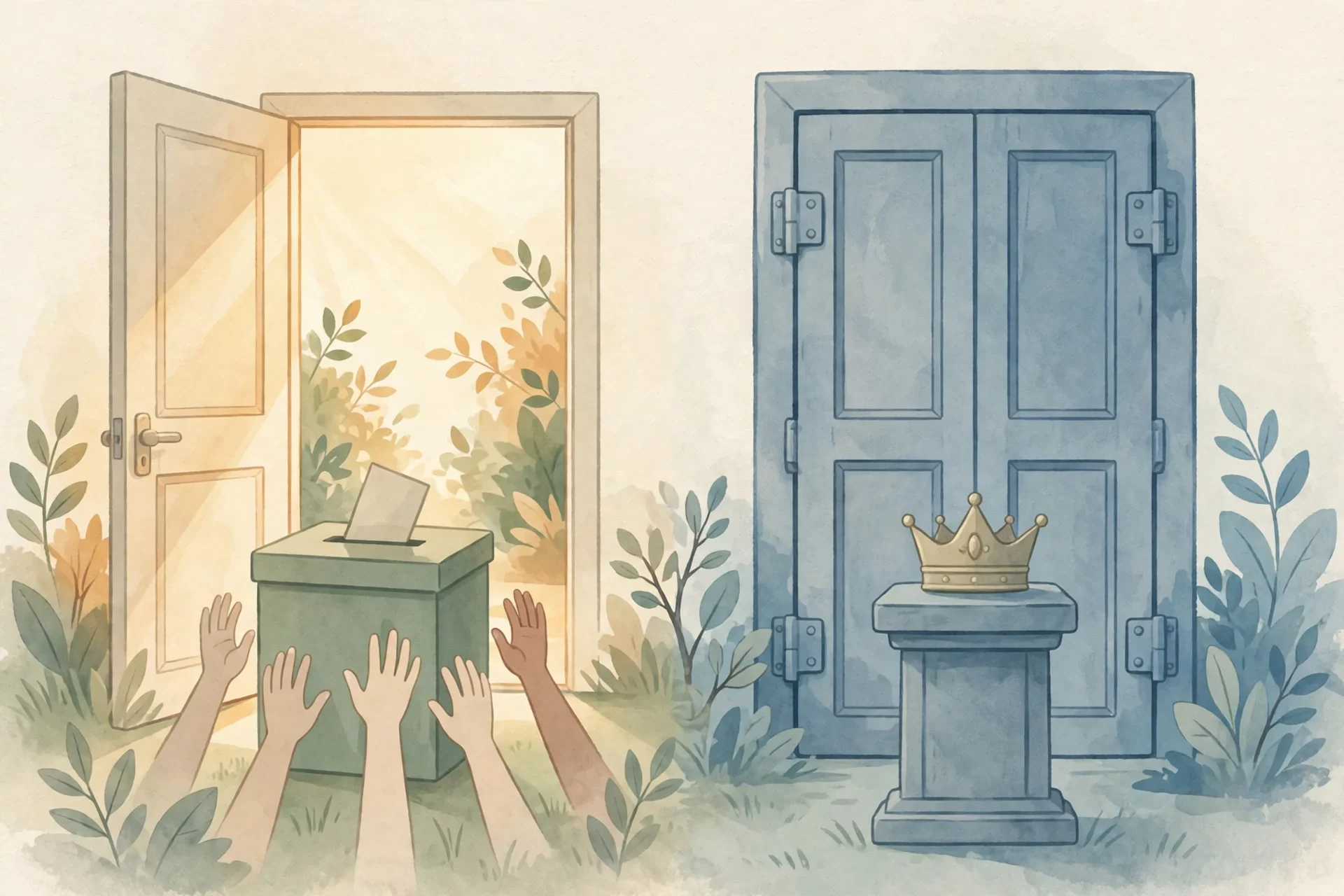
Democracy means government by the people, where citizens vote and take part in decisions. Its main antonyms are tyranny, dictatorship, autocracy, monarchy, oligarchy, authoritarianism, totalitarianism, despotism, fascism, and anarchy. Each word describes a different way power is held, shared, or taken away from the people.
What Democracy Means in Plain Words
Democracy is a form of government in which supreme power rests with the people. Citizens take part in decisions directly, or they choose representatives who act on their behalf. Free elections give ordinary people a regular chance to replace their leaders.
A club or workplace can be democratic too, when every member has an equal voice and vote. Merriam-Webster defines it as government by the people. See the full entry for democracy on Merriam-Webster.
The Origin of Democracy and Its Greek Roots
Democracy comes from Greek demokratia, joining demos, the people, and kratos, rule or strength: rule by the people. It reached English through Middle French democracie and Late Latin democratia.
Merriam-Webster gives the first known use of democracy in English as the 15th century. The idea is older: in ancient Athens, citizens gathered to vote on laws and choose officials. Many antonyms end in cracy, from the same Greek kratos, and name a different kind of rule.
How Democracy Works in Everyday Life
In a democracy, citizens vote in elections, and the result decides who governs for a fixed period. Between elections, people can speak freely, join groups, follow the news, and question those in power. Laws apply to leaders too, and courts can check whether a government has acted within the law.
Democracy also needs quiet habits: listening to opposing views and accepting a result you did not want. An antonym shows one of these features missing.
Democracy in Direct and Representative Forms
There are two main forms of democracy. In a direct democracy, citizens vote on decisions themselves, which works best in small groups such as a club or town meeting.
In a representative democracy, citizens elect people to make decisions for them, as most countries do, since millions of voters cannot gather in one place. Both forms share one core idea: power comes from the people and returns to them at the next election. An antonym breaks that link, giving power by birth, force, or wealth.
Ten Antonyms for Democracy You Should Know
The ten words below are the most useful antonyms for democracy. Some describe rule by one person, some describe rule by a few, and one describes the absence of rule.
1. Tyranny
Meaning: Tyranny is cruel, unfair rule by a person or group holding power without limits.
Examples:
- The novel described a tyranny in which citizens could not speak against the ruler.
- Historians warned that the tyranny grew as courts lost independence.
2. Dictatorship
Meaning: A dictatorship is a system where one person or a small group holds complete power, without free elections or real limits.
Examples:
- The country lived under a dictatorship for twenty years before free elections returned.
- She explained how a dictatorship can begin with one leader seizing control of the state.
3. Autocracy
Meaning: Autocracy is government by one person with unlimited power, shared with no voters, parliament, or courts.
Examples:
- The autocracy gave one ruler the final say on every law.
- Students compared autocracy with democracy to see how power flows.
4. Totalitarianism
Meaning: Totalitarianism is a system where the state tries to control nearly every part of public and private life.
Examples:
- Totalitarianism leaves little room for free speech or open debate.
- The book showed how totalitarianism used fear to keep people obedient.
5. Authoritarianism
Meaning: Authoritarianism is a system where leaders hold strong central power and limit political freedoms.
Examples:
- Authoritarianism often keeps elections in name only, with no real choice for voters.
- The report said authoritarianism had grown as newspapers were closed.
6. Despotism
Meaning: Despotism is rule by a despot, a ruler who uses power cruelly and absolutely, with no regard for rights.
Examples:
- Despotism marked a king who taxed his people without giving them a voice.
- The play warned that despotism begins when no one can question the ruler.
7. Monarchy
Meaning: A monarchy is a system where a king, queen, or emperor rules, usually by birth, not by election.
Examples:
- In an absolute monarchy, the king ruled alone and answered to no voters.
- The class asked whether a monarchy could share power with a parliament.
8. Oligarchy
Meaning: An oligarchy is a system where a small group, often rich or powerful families, holds power and shuts citizens out of decisions.
Examples:
- The oligarchy passed laws that protected the wealth of a few families.
- Critics said the city had become an oligarchy run by a small circle of families.
9. Fascism
Meaning: Fascism is a system marked by dictatorial power, strong control over society, and suppression of opposition, often with extreme nationalism.
Examples:
- Fascism rose in the 1920s when democratic institutions in some countries broke down under strain.
- The lesson explained how fascism removed free elections and banned rival parties.
10. Anarchy
Meaning: Anarchy is a state with no government and no central authority, so it has no elected rulers at all. It means no rule, not harsh rule.
Examples:
- After the government collapsed, the region fell into anarchy for months.
- The writer used anarchy for a town where no laws were enforced.
Democracy and Tyranny: The Sharpest Contrast
Tyranny is the sharpest antonym because it reverses the democratic idea. In a democracy, power is shared and limited, and leaders can be removed by voters. In a tyranny, power is held without limits, and the ruler answers to no one.
The word also carries a moral judgement other antonyms lack. Writers use tyranny when a ruler is not only powerful but cruel and unfair, so use it when the point is the abuse of power, not just its concentration.
Democracy and Dictatorship: Power Held by One Person
A dictatorship concentrates power in one person or a small group, and it removes the two features that define democracy: free elections and limits on power. Citizens may still vote, but the vote changes nothing, because opposition parties are banned or results are fixed.
The word is common in news and history writing. Some dictatorships are run by a single leader, others by a military council or a single party. When you write about one, name the missing feature, such as free elections, a free press, or independent courts.
Democracy and Monarchy: Rule by a King or Queen
Monarchy is a useful antonym for democracy when the contrast is about how a ruler gains power. In a democracy, leaders are chosen by voters for a fixed term. In a monarchy, the ruler usually inherits the position and holds it for life.
The contrast needs care, because many modern monarchies are also democracies. In a constitutional monarchy, the monarch is ceremonial while an elected parliament holds real power. Use monarchy as an antonym only for absolute monarchy, where the ruler holds real power without an election.
Democracy and Oligarchy: Rule by a Small Group
An oligarchy shifts power from the many to the few: a small group, often linked by wealth, family, or rank, decides while most citizens have no real say. Elections may exist, but they change little, since the same circle controls the candidates.
The word fits when the problem is a closed group, not one ruler. A dictatorship points at a single person, while an oligarchy points at a network that keeps power in the same hands year after year.
Democracy and Anarchy: Order Without a Government
Anarchy is the odd word here, because it means no government at all rather than a harsh one. A democracy has laws, courts, and elected leaders; anarchy has none of these.
The word is often used loosely to mean disorder, which can mislead. In political writing, anarchy means the absence of a state, not just a noisy protest. Use it as an antonym for democracy only when the point is the absence of government.
Common Mistakes When Using Democracy Antonyms
The most common mistake is to treat all ten antonyms as exact synonyms. They are not: tyranny stresses cruelty, dictatorship one ruler, autocracy unlimited power, and oligarchy a small group.
A second mistake is to use monarchy without checking its kind. A constitutional monarchy can sit inside a democracy, so add absolute when you mean rule without limits. A third mistake is to call any government you dislike a dictatorship. Both words have clear meanings, so name the missing feature instead: no free elections, no free press, or no independent courts. A fourth mistake is to mix up anarchy and tyranny: anarchy means no ruler, tyranny means a ruler with no limits.
Democracy or Tyranny? Choosing the Right Word
Democracy or tyranny is the choice most writers face when they need a strong contrast. Pick democracy when power comes from voters, when leaders can be removed, and when laws limit what rulers can do. Pick tyranny when a ruler holds power without limits and uses it in a cruel and unfair way.
Ask three questions first. Who holds power, the people or one ruler? Can voters remove the rulers in a free election? Do laws and courts limit them? If the answers point to voters and limits, the word is democracy. For softer contrasts, use dictatorship for one ruler without free elections, oligarchy for a small group, and anarchy for no government.
Frequently Asked Questions About Democracy Antonyms
What is the best antonym for democracy?
Tyranny is the most direct antonym, reversing rule by the people and adding cruel, unlimited power. Dictatorship is a close second, and often better as a neutral term for one ruler without free elections.
Is monarchy an antonym for democracy?
Monarchy is an antonym only for absolute monarchy, where a king or queen rules without an election. In a constitutional monarchy, the monarch is ceremonial and an elected parliament holds real power.
What is the difference between dictatorship and tyranny?
A dictatorship is a system where one person or a small group holds complete power without free elections. Tyranny adds cruel use of that power, so writers choose it when abuse is the point.
Is anarchy the opposite of democracy?
Anarchy is an opposite because it has no elected government at all, but it differs from tyranny and dictatorship. Those words mean harsh rule by someone, while anarchy means no rule by anyone.
How do I choose the right antonym for democracy in a sentence?
Start with the missing feature. No free elections: dictatorship. A small group in power: oligarchy. One cruel, unlimited ruler: tyranny. No government at all: anarchy.
Conclusion: Democracy and Its Opposites in One Place
Democracy means rule by the people, and its antonyms show what happens when that link breaks. Tyranny, dictatorship, and autocracy put power in one pair of hands, oligarchy gives it to a small group, and monarchy gives it by birth. Totalitarianism and authoritarianism extend state control, fascism adds suppression of opposition, and anarchy removes government altogether.
Each word carries its own shade of meaning, so check who holds power, whether voters can remove them, and whether laws limit them, and the right word will follow. Used with care, these ten antonyms make writing about democracy clearer and easier to understand.

I’m Noreen Akbar, an English language researcher and content writer with a passion for words,their meanings, origins, and the subtle differences between them. I specialize in antonyms and vocabulary, creating clear, easy-to-follow guides that help readers expand their word power, sharpen their understanding of language, and express themselves with greater clarity and confidence.