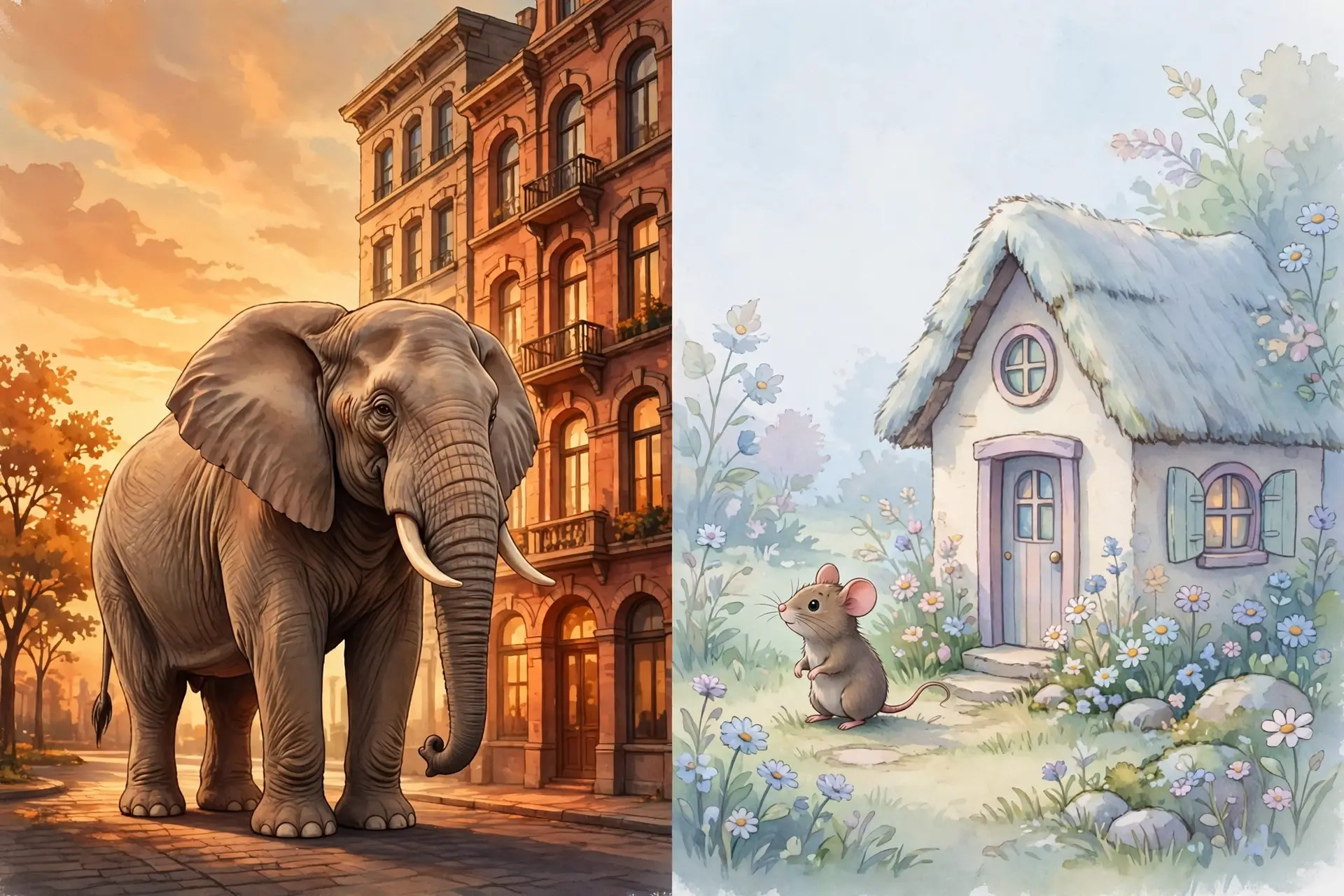
The best antonyms for big are small, little, tiny, miniature, and minor. Small and little are the usual opposites for size. Tiny and miniature stress very small size, while minor fits when big means important rather than large. The right choice depends on whether big describes size or importance.
What Does Big Really Mean?
Big is one of the first adjectives English learners meet, and it does a lot of work. At its simplest, big means large in size, as in a big house or a big dog. It can also mean large in amount, as in a big crowd. And it can mean important, as in a big decision or the big moment of a match. Merriam-Webster lists big as large or great in dimensions, bulk, or extent, and also as of great importance or significance. You can read the full big on Merriam-Webster to see all of its senses.
Because big covers both size and importance, it has no single exact opposite. Small and little are the usual answers, but tiny, miniature, and minor each fit a different corner of the word. This guide explains all five, with clear meanings and examples, so you can pick the right one every time.
Big in Size: The First Meaning of Big
The first and most common meaning of big is large in size. A big elephant, a big mountain, a big box. When big means size, the opposite is small. A small elephant would be a young one. A small box holds less than a big box. Little works the same way, with a softer, warmer feeling. A little house sounds cosy. A small house sounds plainly factual. Both are correct, and the difference is mostly tone.
Size is also where tiny and miniature live. Tiny means extremely small, much smaller than small. A tiny ant is smaller than a small ant. Miniature means made in a very small copy of something larger, like a miniature train or a miniature painting. These two are stronger than small, so save them for moments when small feels too weak.
Big in Importance: The Second Meaning of Big
Big often has nothing to do with size. A big decision changes your life. A big day is a day that matters and a big company employs thousands of people. In these sentences, big means important, serious, or powerful. The opposite here is not small. A small decision sounds odd when you mean an unimportant one. The right word is minor. A minor decision is one that matters little. A minor problem is one you can fix in a minute and a minor character in a story appears for a few lines and then leaves.
This is the mistake most writers make with big. They reach for small when the sentence is really about importance. If you can replace big with important, the opposite is minor. If you can replace big with large, the opposite is small or little.
Where Does the Word Big Come From?
Big comes from Middle English big and bigge, and its deeper origin is uncertain. Merriam-Webster notes it is perhaps of Scandinavian origin, akin to the Norwegian dialect word bugge, meaning an important man. That is a useful clue. From the start, big carried both ideas at once: large size and great importance. The adjective was first used in English in the 14th century, in a sense close to great strength. The adverb followed in 1568, and the noun, meaning a person or organisation of great importance, arrived in 1833. Today big is one of the most common adjectives in English, and it appears in phrases like think big, talk big, and dream big.
How to Say Big: Pronunciation and Forms
Big is pronounced /bɪɡ/, one short syllable. It rhymes with pig, dig, and wig. Its comparative form is bigger, and its superlative is biggest. Both double the g, following the usual rule for short words that end in a single vowel plus a consonant. The noun form is bigness, and the adverb is bigly, though bigly is rare in everyday writing. Big also works as an adverb, as in won big or think big, and as a noun in the plural, the bigs, meaning people or organisations of great power, especially in sport.
Five Antonyms for Big, Explained One by One
Here are the five antonyms for big, each with a clear meaning and two examples. The first two cover size. The next two cover very small size. The last one covers importance.
1. Small (Adjective)
Meaning: Little in size, amount, or extent; not large.
Examples:
- She lives in a small flat near the station.
- The shop sells small bottles of juice for children.
2. Little (Adjective)
Meaning: Small in size or amount, often with a warm or gentle feeling.
Examples:
- A little bird sat on the garden fence.
- He gave his little sister a hug before school.
3. Tiny (Adjective)
Meaning: Extremely small, much smaller than small.
Examples:
- A tiny crack ran across the phone screen.
- The baby wore tiny shoes that fit in my hand.
4. Miniature (Adjective)
Meaning: Very small, or a small copy of something larger.
Examples:
- The museum shows a miniature model of the old castle.
- She paints miniature portraits on pieces of wood.
5. Minor (Adjective)
Meaning: Of little importance, seriousness, or rank; not major.
Examples:
- The car had only minor damage after the bump.
- He played a minor role in the school play.
Big or Small? A Side by Side Comparison of Big Antonyms
| Antonym | Meaning | When to Use | Example |
|---|---|---|---|
| Small | Little in size or amount | General size, any writing | A small room |
| Little | Small, with a warm feeling | Friendly writing, children, pets | A little puppy |
| Tiny | Extremely small | When small feels too weak | A tiny seed |
| Miniature | A small copy of a larger thing | Models, copies, art | A miniature train |
| Minor | Of little importance | When big means important | A minor delay |
Big Mistakes Writers Make With Big and Small
These four mistakes catch writers again and again. Each one has a simple fix.
Mistake 1: Using small for importance.
Wrong: “It was a small decision, so nobody cared.”
Right: “It was a minor decision, so nobody cared.”
If the decision mattered little, minor is the word.
Mistake 2: Using tiny when small is enough.
Wrong: “He lives in a tiny flat with two bedrooms.”
Right: “He lives in a small flat with two bedrooms.”
Tiny means extremely small, so a two bedroom flat is small, not tiny.
Mistake 3: Using little in formal writing.
Little is warm and informal. In a formal report, write small. “A small increase in sales” sounds more formal than “a little increase in sales.”
Mistake 4: Confusing miniature with tiny.
Miniature describes a small copy of a larger thing, like a miniature car. A tiny car is just a very small real car. The two words are not interchangeable.
Big Words in Real Life: Everyday Examples of Big and Its Opposites
Here is how big and its opposites look in different kinds of writing.
A professional email
“The big project starts on Monday, but the minor tasks can wait until Friday.” Here big means important, so minor is its partner, not small.
A news headline
“Small Shop Wins Big Award in Town Contest” Small describes size, big describes importance, and both appear in one line.
A social media post
“Our little dog met a big dog at the park today, and the tiny puppy stole the show.” Three size words, three different shades.
A formal document
“The company reported a minor delay to the big launch, and a small rise in costs.” Formal writing uses minor for importance and small for amount.
When Big Does Not Mean Large
Big appears in many phrases where size is not the point. A big fan is an enthusiastic supporter. A big talker is someone who boasts. To think big is to plan on a large scale. To win big is to win a large amount. In none of these does small work as the opposite. The opposite of a big fan is not a small fan. It is someone who is not a fan at all. The opposite of think big is think small, but here small means narrow thinking, not small size. Context decides the opposite, not the word alone.
Big or Little: Choosing the Right Word for Big
Small and little are close cousins, and learners often ask which one to use. Small is neutral and factual. It works in every register, from formal reports to casual chat. Little is warmer and more personal. It suits children, pets, and things we feel fond of. A little gift sounds kind. A small gift sounds plain. In formal writing, choose small. In stories and friendly writing, little often feels better. When in doubt, small is always safe.
Big in Phrases: Think Big, Talk Big, Dream Big
Big lives in phrases that English speakers use every day. Think big means to plan ambitiously. Talk big means to boast about what you will do. Dream big means to hope for great things. Win big means to gain a lot. Go big means to do something on a large scale. Big shot means an important person. Big deal means something important, or, said with a shrug, something unimportant. These phrases show how far big has travelled from simple size. Its opposites change with each phrase, which is why learning the five antonyms above matters more than memorising one.
Big Questions Readers Ask About Big and Its Antonyms
What is the opposite of big?
The usual opposite of big is small. Little works too, and tiny and miniature fit when something is very small. When big means important, the opposite is minor.
Is little the same as small?
Almost, but not quite. Both mean not large. Small is neutral and works everywhere. Little is warmer and more personal, and it suits children, pets, and things we feel fond of.
When should I use tiny instead of small?
Use tiny when something is extremely small, far smaller than ordinary small things. A tiny seed, a tiny crack, a tiny room. If small already says enough, tiny will sound exaggerated.
What is the opposite of big when it means important?
Minor. A big decision is an important one, so its opposite is a minor decision. A big problem is serious, and a minor problem is easy to fix.
Can big and small describe the same thing?
Yes, in different ways. A small company can win a big award. A big house can have a small garden. Size and importance are separate ideas, and big covers both.
Conclusion: Big Made Simple
Big is a short word with a wide reach. It means large in size and great in importance, and its opposites change with its meaning. Small and little cover size. Tiny and miniature cover very small size. Minor covers low importance. Remember the simple test. If you can replace big with large, use small or little. If you can replace big with important, use minor. Learning these five words will make your writing clearer and your vocabulary stronger. Try using one of them in a sentence today, and keep practising a new antonym every day. The more you use them, the more natural they will feel, and the right opposite will come to you at once.

I’m Noreen Akbar, an English language researcher and content writer with a passion for words,their meanings, origins, and the subtle differences between them. I specialize in antonyms and vocabulary, creating clear, easy-to-follow guides that help readers expand their word power, sharpen their understanding of language, and express themselves with greater clarity and confidence.