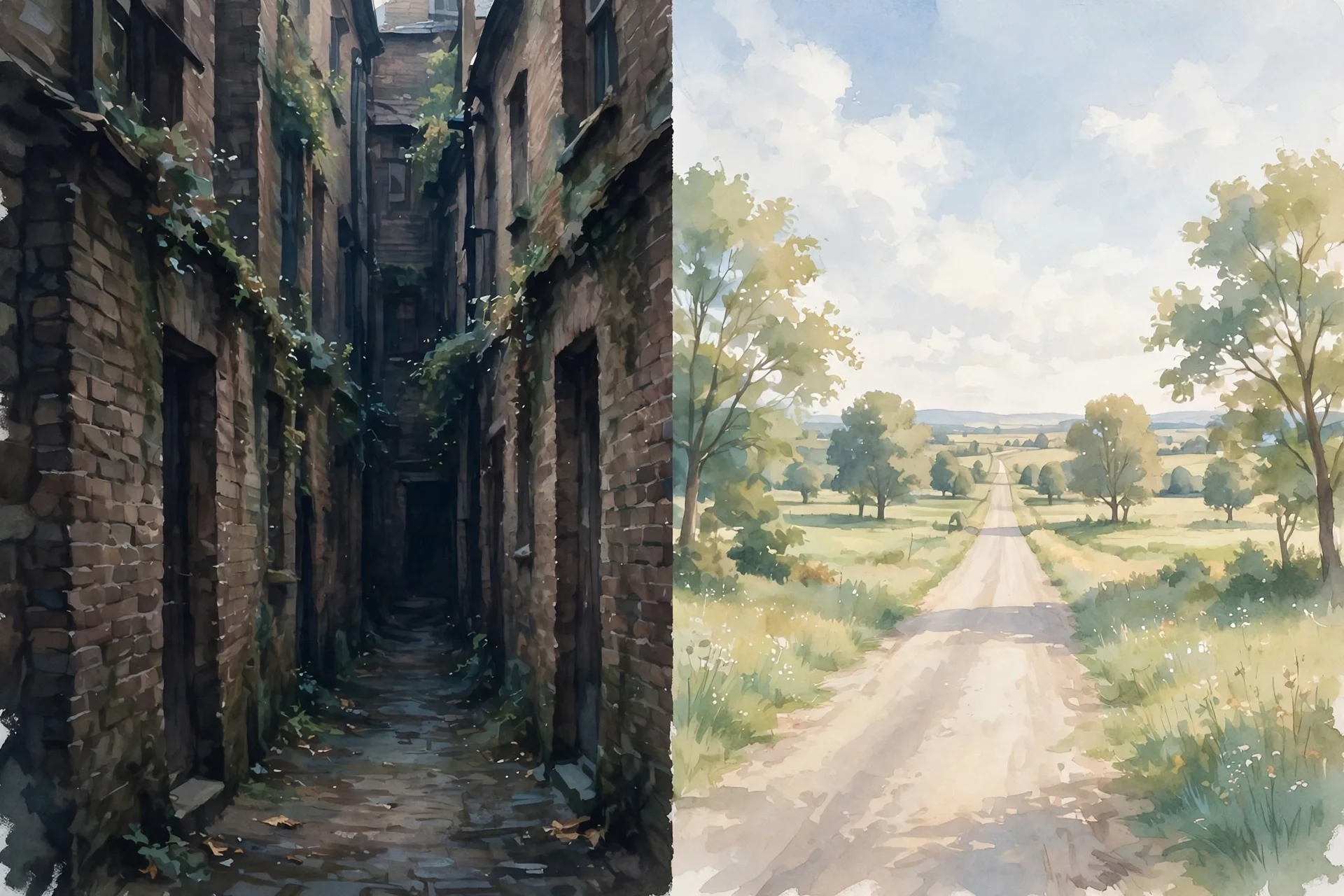
The best antonyms for alley are highway, boulevard, and main street. An alley is a narrow passage between buildings, while its opposites are wide, open, and busy routes. This guide lists ten clear antonyms for alley, explains each meaning, and shows how to use them in real sentences.
What Does Alley Mean?
An alley is a narrow street, usually a passage between or behind buildings. Merriam-Webster defines it as a narrow street, especially a thoroughfare through the middle of a block giving access to the rear of lots or buildings. In plain terms, it is a small, quiet route serving the backs of houses, shops, and offices.
The word has other senses too: a garden walk bordered by trees, a bowling enclosure, and a region where a type of destructive weather occurs often, as in Tornado Alley. In everyday speech, though, the narrow street sense is the usual one. For the full dictionary entry, see alley on Merriam-Webster.
The Origin and History of Alley
Alley has a long history in English. It comes from Middle English, borrowed from Anglo-French alee, from the verb aler, meaning to go. The first known use dates to the 14th century, in the sense of a walk or passage. That origin suits the word: an alley is, at heart, a way to go from one place to another.
Over the centuries the meaning widened: garden walks lined with trees took the name, then bowling lanes, then the narrow back streets of growing towns. A second, separate noun shares the spelling: a small marble used in games, shortened from alabaster, first known in 1720. The street sense has always been the main one, and it still shapes how we picture an alley today.
Why the Word Alley Needs Clear Opposites
Every word is clearer beside its opposite, and alley is a good example. On its own it suggests narrowness, shadow, and quiet. Set it against a highway or a boulevard and the picture sharpens: the alley is small and enclosed, while its opposite is wide, bright, and busy.
Opposites also help writers choose the right word. A scene in a back alley feels tense and secret, while the same scene on a main street feels open and public. Ten strong antonyms give you range to match the road to the mood.
How to Use Alley in a Sentence
Alley is a noun, and it usually appears with simple prepositions: down, in, through, and behind the alley. It pairs naturally with back, narrow, dark, and quiet, and with verbs of movement such as walk, run, turn, and slip.
Here are two natural examples:
- The cat darted down the alley and vanished behind the bins.
- We took a shortcut through the alley to reach the market.
In each sentence the alley is the smaller route. That contrast is what makes its opposites useful.
The 10 Best Antonyms for Alley
These ten words oppose alley in different ways: some are wider roads, some are open public spaces, and some describe open land itself.
1. Highway
Meaning: A main public road that connects towns and cities and carries fast, heavy traffic.
Examples:
- The highway carried us across the state in under three hours.
- Trucks thunder along the highway all night, while the alley behind our house stays silent.
2. Boulevard
Meaning: A wide street in a town or city, often lined with trees.
Examples:
- The new boulevard has cafes, benches, and rows of young plane trees.
- We left the narrow alley and stepped onto a bright, tree lined boulevard.
3. Main Street
Meaning: The principal street of a town, where the main shops and offices stand.
Examples:
- Every shop that matters in town has an address on Main Street.
- The parade marched down Main Street, far from the quiet alley where we had parked.
4. Avenue
Meaning: A broad road, often lined with trees, that runs through a town.
Examples:
- The avenue leads straight from the station to the palace gates.
- She traded the shadowed alley for a sunlit avenue with room to breathe.
5. Thoroughfare
Meaning: A road open at both ends that serves as a main route through a place.
Examples:
- The old market road is still the busiest thoroughfare in the district.
- Unlike the alley, which ends at a brick wall, the thoroughfare runs clear through town.
6. Expressway
Meaning: A high speed divided highway for fast travel, with limited entrances and exits.
Examples:
- The expressway cut the journey to the airport down to twenty minutes.
- Delivery vans prefer the expressway, not the tight alley behind the shops.
7. Plaza
Meaning: An open public square in a town or city, often surrounded by shops.
Examples:
- Children played in the plaza while musicians performed near the fountain.
- The alley felt cramped after the wide, open plaza with its sky overhead.
8. Square
Meaning: An open area where streets meet, often surrounded by buildings.
Examples:
- The farmers market fills the square every Saturday morning.
- We met at the square, a world away from the dark alley behind the inn.
9. Open Field
Meaning: A wide stretch of open land with no buildings or walls closing it in.
Examples:
- The path led out of the town and into an open field full of wildflowers.
- An alley shuts out the sky, while an open field gives you the whole horizon.
10. Parkway
Meaning: A broad road lined with trees and grass, built for pleasant driving.
Examples:
- The parkway winds through green lawns on its way to the lake.
- He cycled along the parkway instead of squeezing through the alley shortcut.
Alley Versus Open Spaces in Daily Life
The contrast is easy to feel. An alley is enclosed: walls rise on both sides, the sky is a thin strip above, and sound stays close. Its opposites are open: light pours in, air moves freely, and you can see far ahead.
Alleys suit quiet errands and shortcuts, while boulevards and plazas suit meeting friends and public life. The choice tells the reader at once whether the scene is hidden or open, private or public.
Common Mistakes People Make With Alley
One common mistake is spelling. Alley, the narrow passage, is often confused with ally, a friend or supporter, and alloy, a mixture of metals. The three sound alike, so check the spelling first.
Another mistake is using alley for any small street. A lane is usually a narrow country road open at both ends, while an alley often runs behind buildings or ends at a wall.
A third mistake is taking phrases literally. A blind alley is not only a passage with no exit; it is also a line of thought that leads nowhere.
Alley in Literature, Films, and Everyday Speech
Alleys have a strong life in stories. They set the scene for secrets, chases, and chance meetings, from detective novels to chase scenes in films. The narrow, shadowed space creates tension that a wide boulevard cannot.
Everyday speech uses the word too. Something right up your alley suits you well, like a hobby you love or a job that fits your skills. A bowling alley is a long lane where the game is played, and in the Harry Potter books Diagon Alley is a hidden shopping street for wizards.
Alley and Its Opposites in Different Places
The word changes a little from place to place. In the United States it usually means the service lane behind a row of buildings. In Britain it can also be a narrow footpath between houses, and regional words like snicket, ginnel, and twitten describe similar passages in the north of England.
Its opposites vary by place as well. Paris is famous for its grand boulevards, American towns gather around a main street, and many European cities centre on a plaza or square.
Choosing the Right Opposite for Alley
The best opposite depends on the sense you mean. For roads, choose highway, boulevard, main street, avenue, thoroughfare, expressway, or parkway. Each names a wider, busier, or grander route than an alley.
For enclosure, choose plaza, square, or open field: places with sky above and room around. For traffic and speed, expressway is the sharpest contrast. Match the opposite to the idea in your sentence, and the contrast will land cleanly.
Alley or Highway?
| Feature | Alley | Highway |
|---|---|---|
| Width | Narrow, one vehicle at most | Wide, several lanes |
| Purpose | Rear access, shortcuts | Travel between towns |
| Traffic | Light, slow, mostly on foot | Heavy, fast, mostly vehicles |
| Feeling | Enclosed, quiet, private | Open, busy, public |
| Light and air | Limited, walls close by | Open sky, free air |
An alley and a highway are opposite ends of the road. The alley serves the small, local, and hidden needs of a place, while the highway serves the large, public, and distant ones. A town needs both: the highway brings people in, and the alley lets them reach the back door.
Frequently Asked Questions About Alley
What is the opposite of alley?
The best opposites are highway, boulevard, and main street. A highway is a wide main road, a boulevard is a broad tree lined street, and a main street is the principal street of a town. Each reverses the narrow nature of an alley.
What is the difference between an alley and a lane?
A lane is usually a narrow road open at both ends, often in the countryside or a village. An alley more often runs between or behind buildings in a town or city, and it may end at a wall.
Is alleyway the same as alley?
Yes, alleyway means almost the same as alley: a narrow passage between buildings. It is slightly more informal and is often used when the passage feels like a walkway rather than a road. In most sentences the two can be swapped without changing the meaning.
What does “right up your alley” mean?
The phrase means something suits you well or matches your interests and skills. If a puzzle is right up your alley, you enjoy that kind of challenge.
What is Tornado Alley?
Tornado Alley is a region of the central United States where tornadoes occur often, stretching from Texas north through Oklahoma, Kansas, and Nebraska. The name borrows the idea of an alley as a long, narrow passage, this time a corridor of land where storms travel.
Quick Recap: Alley and Its Opposites
An alley is a narrow, enclosed passage between or behind buildings, a word in use since the 14th century. Its ten best opposites are highway, boulevard, main street, avenue, thoroughfare, expressway, plaza, square, open field, and parkway. Wide roads oppose its narrowness, while plazas, squares, and open fields oppose its enclosure. Pick the opposite that matches your sentence.
Conclusion: Alley in a Wider World
Alleys will always have their place. They carry deliveries, hide shortcuts, and give stories their secrets. Yet they only make full sense beside their opposites: the highways that join cities, the boulevards where people stroll, the main streets where towns gather, and the open fields where the sky takes over. Learning the antonyms for alley is not only about vocabulary. It is about seeing how language maps the places we live in, from the narrowest passage to the widest road.

I’m Moazama Akbar, an English language researcher and content writer with a passion for helping people build stronger vocabulary and language skills. I create clear, well-researched guides on antonyms, opposite words, and word meanings, designed to make English learning simple, practical, and enjoyable for students, writers, and learners everywhere.